Having trained 80,000 people in AI, I’m convinced the hardest part of an AI programme comes after the licences are bought.
By then, the launch email has gone out and, most likely, someone from the team has built a SharePoint page with links. Only a few months later, when the tool has been activated thousands of times, somebody starts asking what the money bought in the first place.
That question has an answer, and it rarely has anything to do with the tool.
The gap nobody talks about
There’s a gap between companies that have simply bought an AI tool and those that have actually got value from using it.
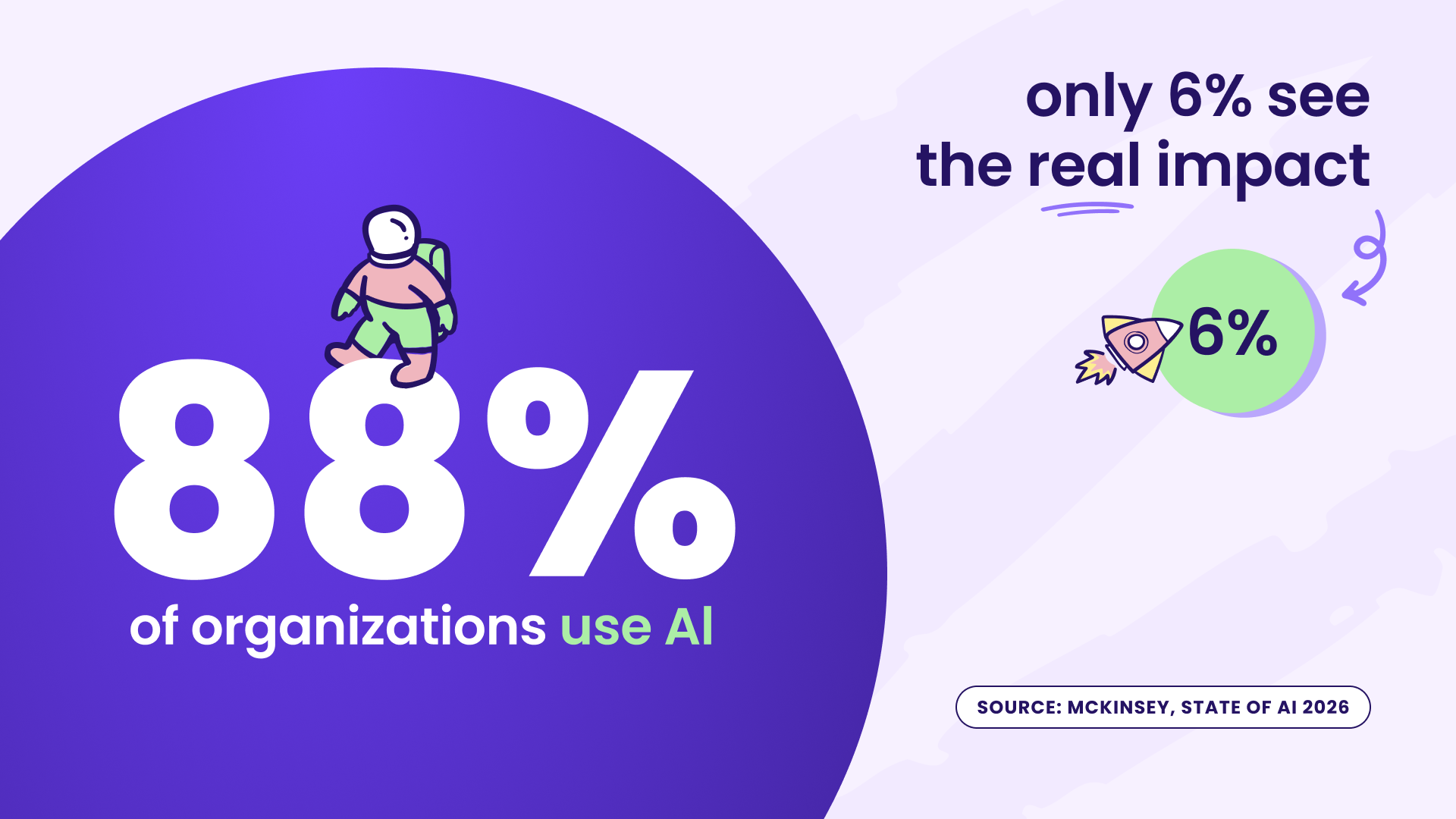
McKinsey says 88% of organisations now use AI in at least one function, yet only around 6% report real impact. BCG found the same thing from another angle: 26% out of the 2,700 executives surveyed have moved beyond pilots to achieve value at scale.
Both groups run the same models, so the technology is not what makes the difference. The difference comes from the people using it. Most of them were never taught the how-tos, so naturally, an AI tool nobody knows how to use ends up being a screensaver on the company laptop.
So why do people leave a paid AI licence unused?
There are three main reasons:
1. Nobody trained them. Salesforce found that 69% of workers surveyed recieved no training from their employer on using AI at work. Similarly, Microsoft reported that the share of AI users who received company training was only 39%. If nobody teaches workers how to use a tool, they will probably open it once and never return to it.
2. They are afraid of losing their jobs. In a PwC survey of 56,000 workers worldwide, 37% expressed concern that AI might replace their jobs. People who are afraid don’t experiment. They’re not motivated to use, test, or learn the tool. As a result, the tool just never becomes part of their work.
3. Nobody taught them judgment. Using AI without human input doesn’t promise the expected output quality. There’s a thin line between what AI provides and what is good enough to use.
Meanwhile, people are finding their own way around the problem. Cyberhaven measured a 485% growth in shadow AI usage in a single year. Microsoft’s Work Trend Index discovered that 78% of AI users bring their own tools to work, while Salesforce found that 55% of employees use AI tools their company has not approved.
Read more: Your AI licences are just expensive screensavers without adoption
Three layers of AI enterprise adoption
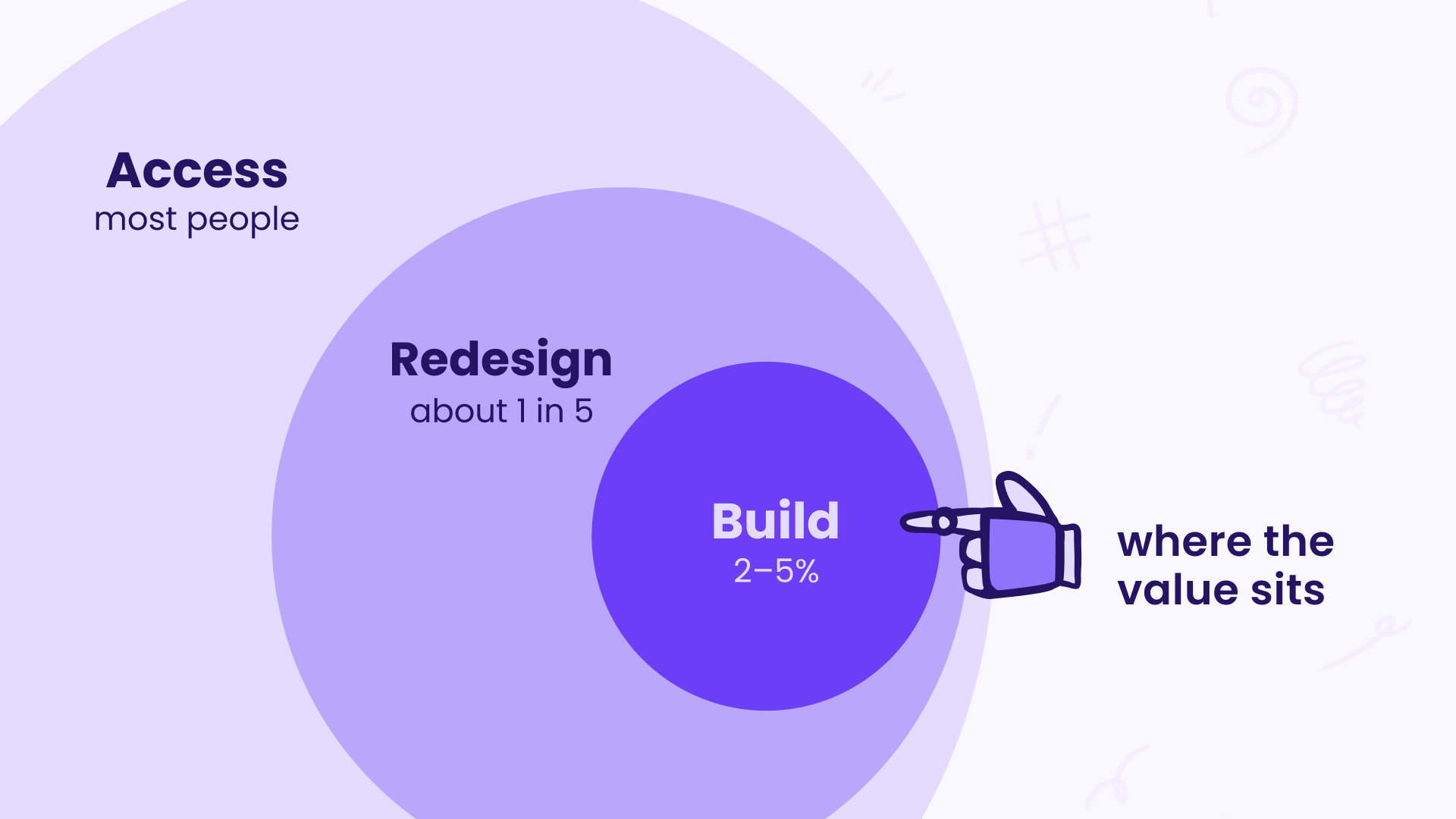
Every enterprise I’ve worked with shows roughly the same pattern of AI adoption. Most people have access to the tool and try it now and then. A smaller group, maybe one in five, uses it regularly. And only a handful, around 2%, use it to build something new.
There are three layers of AI adoption inside a large company:
1. Access. This is the largest group. They have access to the tool, try it, and some even use it every week. Most companies have this layer covered. Nearly 70% of Fortune 500 companies have adopted Copilot. OpenAI has 7 million workplace seats. BBVA has deployed ChatGPT to 120,000 employees.
2. Redesign. There’s a smaller group that stops using AI just as a shortcut and starts changing how they do their work. Citi, for example, built a network of more than 4,000 volunteer accelerators across 182,000 employees and now reports adoption levels above 70%.
At Daimler Truck, the 85% rise in Copilot chat usage came from noticing the curious people, training them, and letting them share their knowledge with others. Networks like this last when the time is ringfenced: champions get three to five hours a week written into their objectives and a direct line to the team that owns the tools.
“The training provided practical insights into AI use cases and helped me better understand how to apply AI tools effectively in my day-to-day work.” - Rohit Singh, Senior Technical Writer at Daimler Truck Innovation Center, India
3. Build. This is a small group, roughly 2–5% of workers. This group builds AI that includes models, custom assistants, automated workflows, and sometimes entire products. They are few, but the value they bring outweighs their numbers.
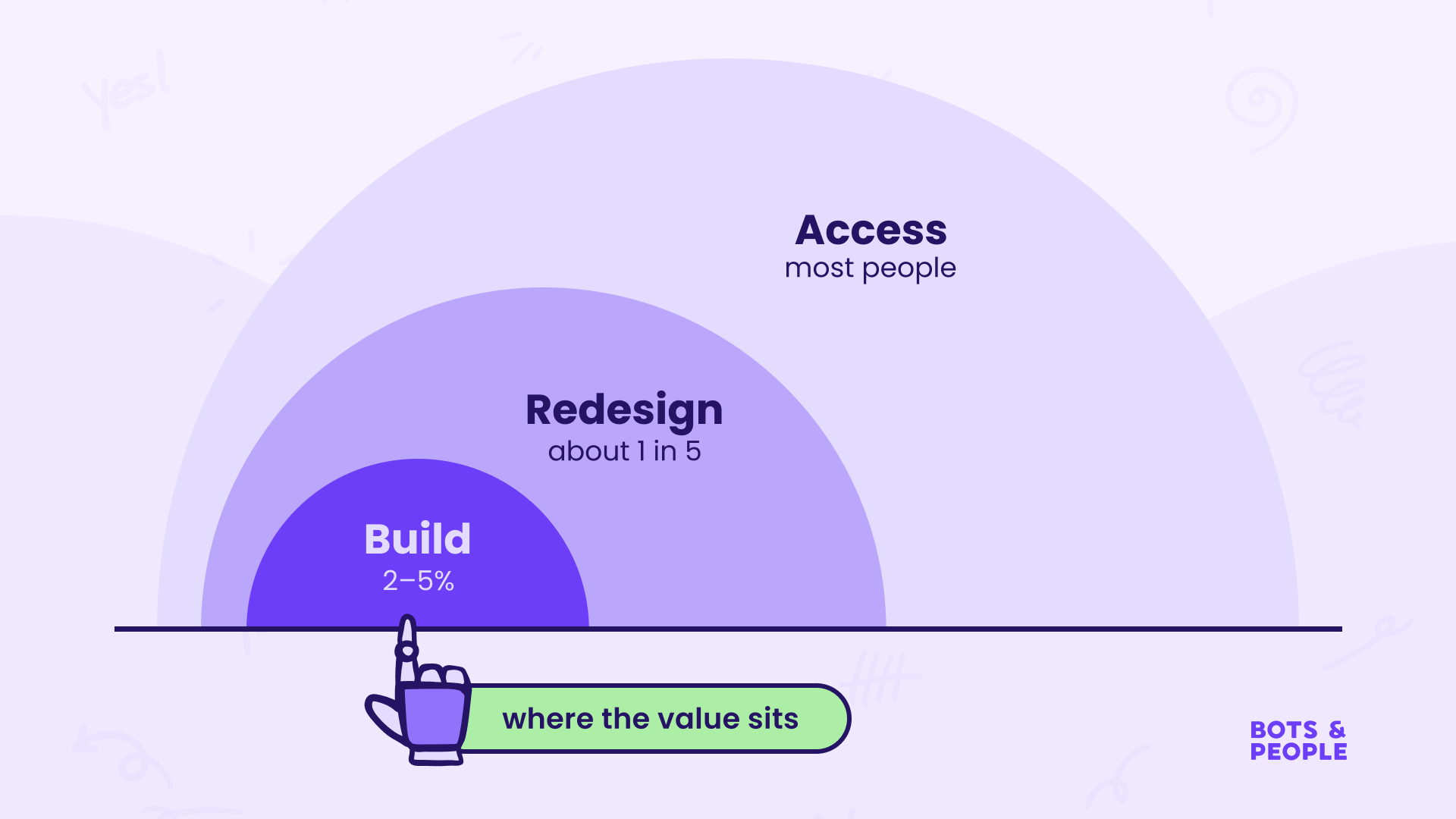
Almost all of the measurable value sits in layers two and three, and people don’t drift up from one layer to the next on their own. Someone has to plan the move and take responsibility for it.
That rarely happens, and the budget shows why. BCG says 10% of AI success comes from algorithms, 20% from technology, and 70% from people and processes. Most budgets run the opposite way. Nearly everything goes on licences, and only a small portion is allocated to the people who are expected to make them useful.
The other reason companies stay stuck is that nobody can show whether the investment paid off. IT can point to real wins, like a support chatbot that cut ticket volume by 30%, but a saved hour rarely turns into a number on the P&L.
L&D reports how people felt about the training, but this says little about their usage of the tool after gaining access to it. At the same time, leadership tends to be far more upbeat than the workforce. In one BCG survey, 76% of executives said employees were enthusiastic about AI, compared with 31% of individual contributors.
Read more: Enterprise AI Adoption: Why Access Is Not Adoption
A better way to upskill
1. Treat upskilling like a product, not a project. Amazon started as an online bookstore with a terrible website, and the same goes for most of the well-known products we use today. They got good because they started. Most companies do the opposite with AI training. They spend months putting effort into perfecting the product, then launch it and wait for results.
A better approach is to start small, with something like a two-hour workshop for one department. Check what changed right away, and implement changes before the next wave.
“The most engaging online training I have done!” - Tim Walwyn, Country Manager, Innomotics
2. Measure the people side, and measure it first. Look at four things:
- Outcomes (Is it creating value?)
- Skills (Can people do it?)
- Adoption (Are they putting it into practice?)
- Culture (Does the organisation support them?)
Ask leadership and employees the same questions. Their answers might differ, and the gap between their answers is valuable feedback.
3. Match the training to where people are. We work with these five levels: discover, understand, use, integrate, and build.
The first two are straightforward and short. Departments work through the next two on their own data because AI only clicks when it solves a real problem. The last level is for the small group we saw, who build agents and keep the scale going.
Read more: Nine Lessons From Training 80,000 People in AI
Intelligence needs human judgement
Every month or so, we get new, updated AI models that make previous models look basic. This makes people ask the same question: We taught everyone to prompt, so what do we teach next?
The answer lies in what to stop teaching. Anything tied to one tool, like the exact prompt format for one model, has a shelf life of around 6–18 months. At the same time, the models are getting better and better at understanding instructions, and the interfaces keep getting simpler. This means one thing: a skill built on the quirks of today’s tool is already on its way out.
Here are the four things that make the difference:
- Decide what to ask AI to do in the first place.
- Judge whether an output is really good or just sounds good.
- Know when AI is the wrong tool and a person should take the job over instead.
- Design the work in a way that lets AI help with the repetitive part and people with the judgment part.
For L&D, this is at the core of what a programme is built around. The companies that build around these capabilities get value that survives every update. The ones that rebuild their workshops with every new release are always starting over.
Intelligence keeps getting more artificial, and that’s not about to change. But the intent behind how we use it is what stays human and can make the difference.
Read more: Intelligence Gets Artificial, Intention Stays Human
So, what now?
Start from the beginning. Ask your people, anonymously, how many times they opened an AI tool for real work in the past five working days. Then, compare it to your licence dashboard. The distance between the two is your adoption rate, and it tells you where to begin.
Download our whitepaper to check out the full argument, backed by real data. And if you’d like to find out where your organisation stands, let’s talk.