Last updated September 2026 · 5 min read · By Nico Bitzer, Co-Founder & CEO, Bots & People
Most companies training AI skills for the first time assume the biggest risk is picking the wrong tool. After training 80,000 people across 30-plus DACH enterprises, that is not what I would flag.
The tool choice matters less than most L&D teams think. McKinsey's State of AI, 2025, found that 88% of organisations now use AI in at least one business function, yet only around 6% capture significant value from it. What actually separates the two groups is a set of much less glamorous decisions: how you measure the programme, who you prioritise first, and whether you treat the whole thing as a single event or as something you keep running. Here are nine lessons we learned the hard way, condensed from two years of running this at scale.
The nine lessons
1. Off-the-shelf learning is not enough. A generic "AI Fundamentals" module rolled out to 10,000 people produces a completion rate, not a capability. A developer living in an IDE and an HR business partner living in Outlook need genuinely different training, built around their actual work, not a shared slide deck.
2. Measure before you train, not after. Most organisations buy a programme, run it, and only then try to work out whether it helped. Measure outcomes, skills, adoption and culture first, design for the specific gaps you find, then measure again. Skipping this step is the single most common mistake we see.
3. Bring the fun back. AI is one of the rare topics people are already curious about, and a compliance-style deck kills that curiosity fast. We call our own approach No More Boring, and every live session we run needs at least one moment that would not feel out of place in a game show.
4. Prioritise the pioneers. In every department there is a 5 to 10% who are already excited and already experimenting quietly. Give them advanced training and a visible stage, and let them pull the rest of the team forward. Chasing the sceptics first usually wastes a training budget.
5. Build an ecosystem, not a blockbuster. The half-life of AI tool knowledge runs somewhere between 6 and 18 months, so a polished e-learning course that takes six months and a six-figure budget to produce is often out of date before it launches. We run a network of over 50 specialist trainers specifically so that when a tool ships an update on a Tuesday, the workshop content can catch up by Thursday.
6. Say it in plain language. Call it "how to talk to an AI," not "prompt engineering." The moment a training description reads like a computer science lecture, most of the organisation quietly opts out, and IT ends up concluding nobody is interested in AI when the real problem was the invitation.
7. Special groups need special formats. A two-hour basics workshop works for the broad middle of a company and fails for executives, developers and sales teams, because each of those groups needs its own design, not a variant of the same one. Executives need coaching next to their own real decisions. Developers need a sandbox in their actual editor.
8. If the top does not lead, the bottom does not follow. A MIT and BCG survey of roughly 3,000 managers found that when leadership visibly champions AI, the value an organisation gets from it can rise by up to 5.9 times (Ransbotham et al., 2024). When a CEO, CHRO or CIO visibly uses AI in front of the organisation, that single example does more for adoption than another mandatory course.
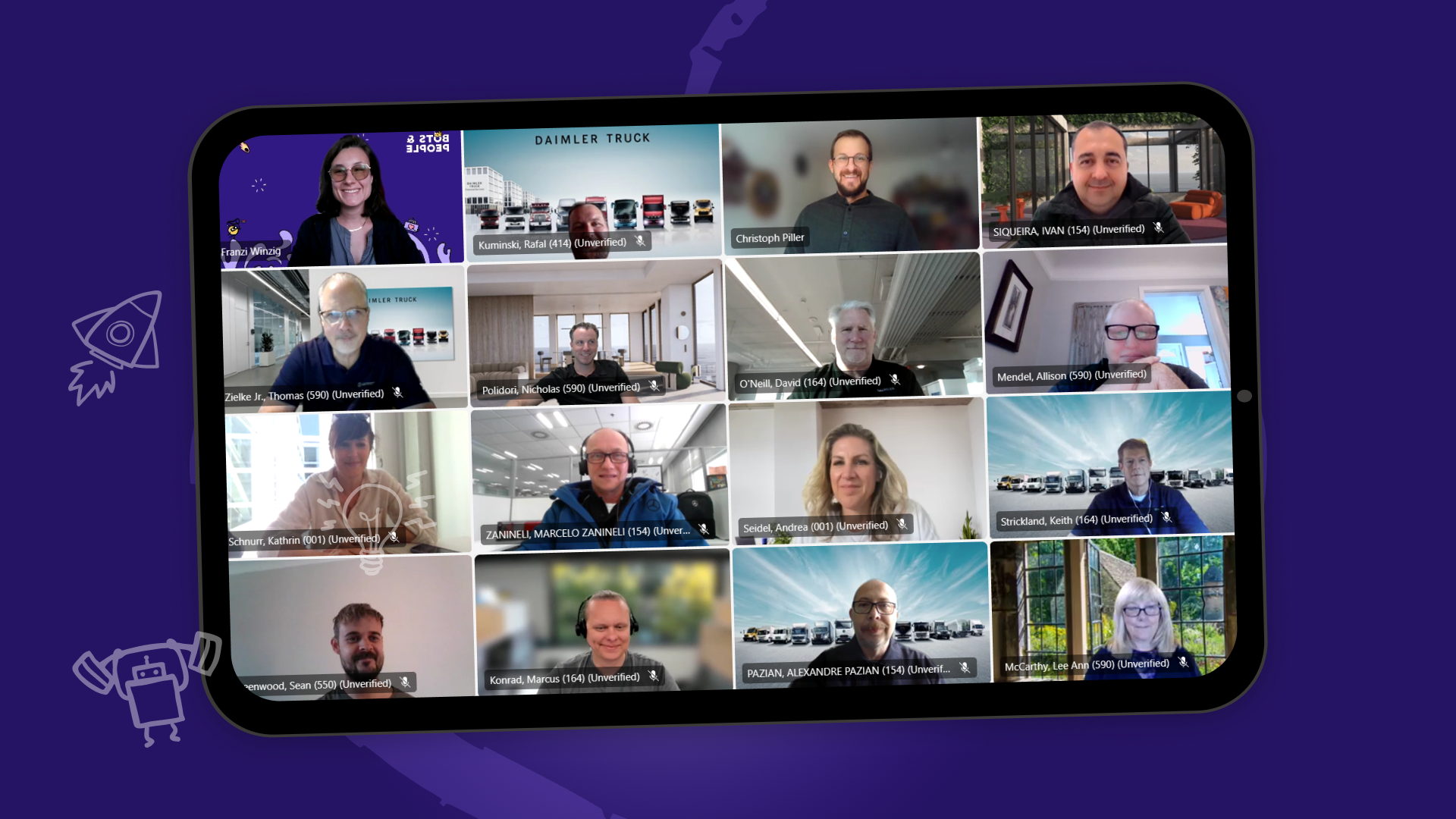
9. One-to-one coaching scales better than it sounds. You do not coach 10,000 people individually. You coach the 200 or so whose behaviour actually shapes everyone else's, and let them multiply it through their teams. At Daimler Truck, an approach inspired by Working Out Loud circles helped drive a measurable jump in daily Copilot Chat usage without a single mandatory session.

"You don't coach 10,000 people individually. You coach the 200 whose behaviour shapes everyone else's, and let them multiply it through their teams."
Nico Bitzer, Co-Founder and CEO of Bots & People.
What to do next
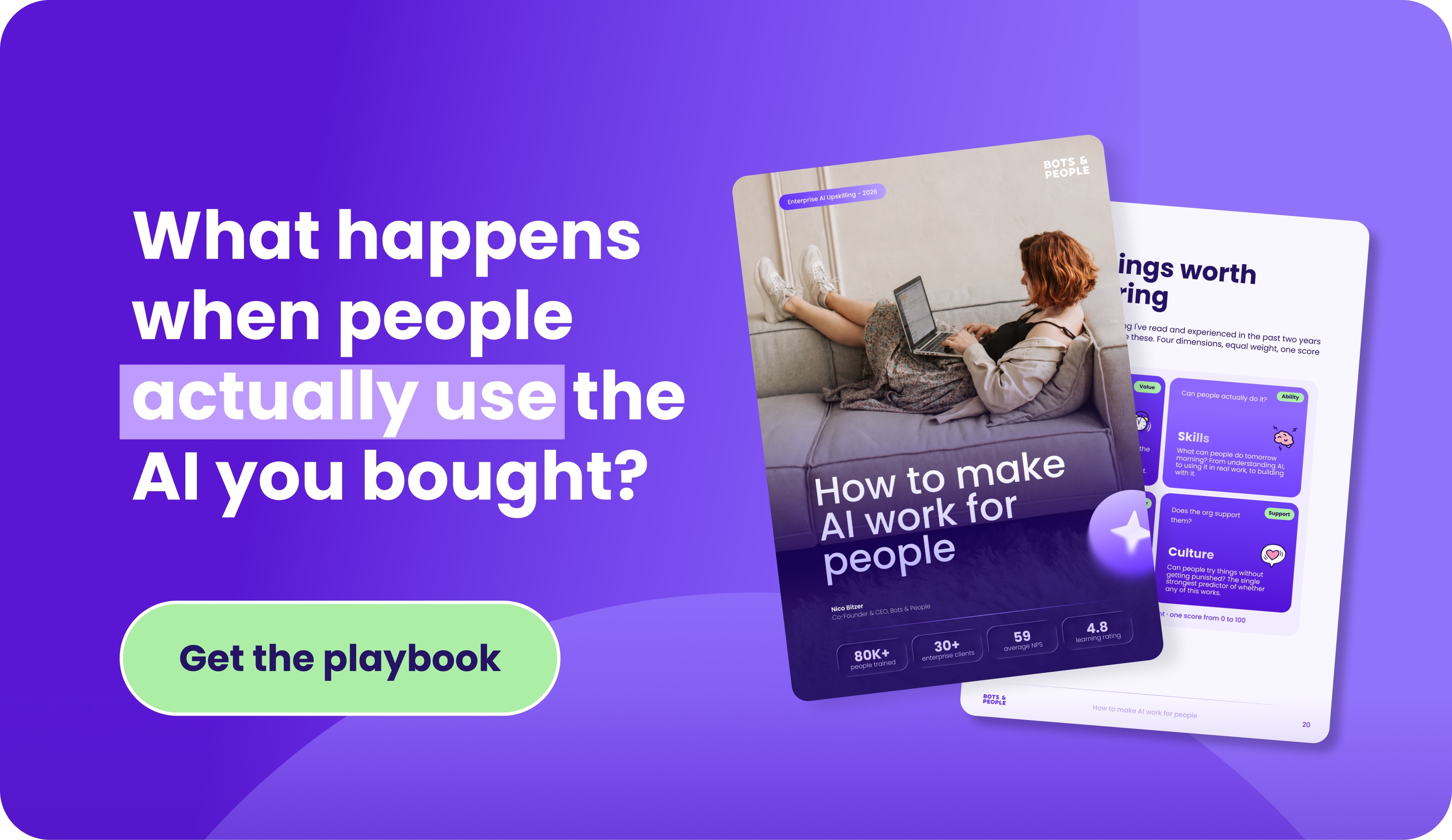
Pick the one lesson on this list that describes your current programme most uncomfortably. That is usually the one worth fixing first, not the one that is easiest to act on. If you want the full measurement framework these lessons come from, the "How to Make AI Work for People" whitepaper walks through the four dimensions we use before we design anything.
Frequently Asked Questions
What is the difference between AI training and AI upskilling?
AI training usually means a single event: a workshop or an e-learning module on a specific tool. AI upskilling is the broader, ongoing effort that includes measurement, role-specific tracks and a feedback loop, judged by whether behaviour changed rather than whether the session happened.
How long does it take to train a large workforce in AI?
Based on our own rollouts, a realistic timeline gets everyone AI-literate within the first month, gets departments using AI daily by around month three, and produces certified internal champions by around month six. It does not stop there, because the tools keep changing.
Why doesn't off-the-shelf e-learning work for AI skills?
It scales well for basic awareness, but it cannot adapt to a specific department's real tasks, and it cannot keep pace with how quickly the tools themselves change. Live, role-specific formats consistently outperform it once the goal moves from awareness to behaviour change.
Who should get 1:1 coaching in an AI upskilling programme?
Not everyone, and that is the point. The highest-leverage group is the 100 to 200 people whose decisions and habits other employees copy: department leads, team managers and visible pioneers, not the workforce at large.