TL;DR
Deutsche Telekom's Createathon gives participants four hours to identify a real use case from their work, build a first AI tool around it and improve it through testing with trainer support.
Across 10 Createathons in 2026, 1,215 people participated, 81% of English-language survey respondents built a working Custom GPT for their specific problem, and participants estimated an average saving of 1.8 hours per week.
Three weeks later, 54% of follow-up respondents were still actively working with Custom GPTs, which suggests that the useful learning outcome was not simply understanding the feature but knowing how to build with it.
Most employees no longer need another explanation of what generative AI is. They have seen ChatGPT, Copilot or another AI assistant, and many already use it for simple tasks such as rewriting emails, shortening text or checking grammar. Those use cases are useful, but they often leave the underlying work untouched. The employee still follows the same process and produces the same output, with AI added as a final editing layer.
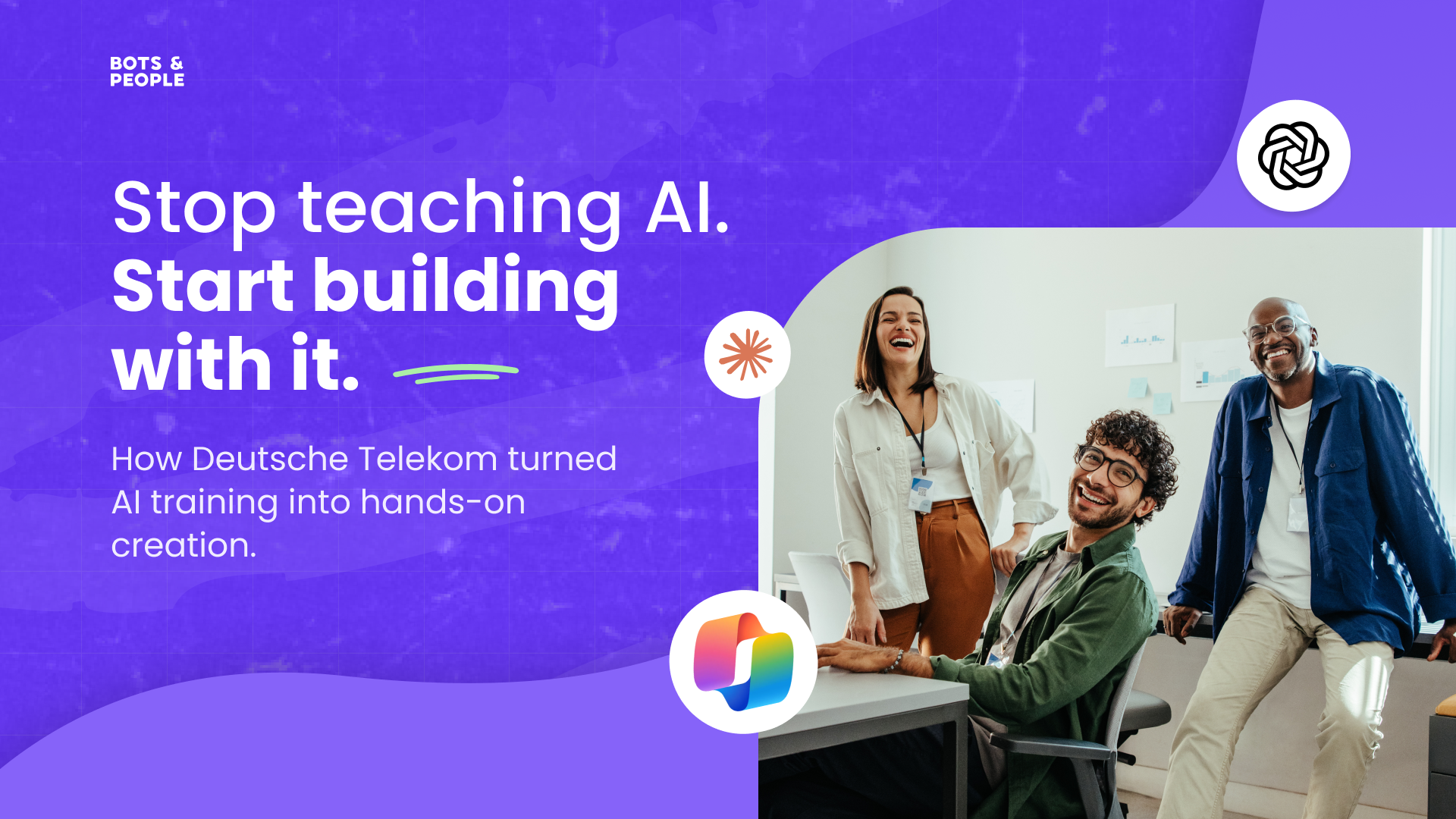
That is the gap the Createathon is designed to address. Developed as a hands-on learning format with Deutsche Telekom, the Createathon gives employees four hours to identify a real problem from their own work, build the first version of an AI tool around it and improve it through testing. Instead of leaving with a list of examples they might try later, participants leave with something they have already built themselves.
The first Createathons focused on Custom GPTs in ChatGPT, but the format is deliberately tool-agnostic. The same learning architecture can be applied to newer AI tools, skills and agents because the real capability is not knowing where to click in a specific product. It is knowing how to recognise a suitable use case, turn it into instructions and refine the result until it becomes useful.
A Createathon starts with the work, not the tool
One of the biggest challenges in AI training is asking employees to come up with relevant use cases before they really understand what is possible. If someone has mainly used AI to write emails, their next idea is often another writing task. The Createathon avoids the blank-page problem by starting with a purpose-built use-case interview prompt.
The prompt interviews participants about their role, recurring tasks and workflows to uncover a problem where AI could add value. A second deep-dive prompt then helps explore the chosen use case and generates the initial setup for the tool. Participants are therefore not handed a generic exercise. They begin with a piece of work they already understand.
That matters because a controller, a project lead and someone working in procurement should not leave AI training with exactly the same use cases. The technology may be the same, but the work is not. Once the discussion moves closer to the function, AI can become more than a writing assistant. It can act as a sparring partner, review information, support a decision or remove repetitive steps from an existing process.
Participants build, test and improve
Once participants have identified possible use cases, they work in groups and select one to build. Trainers guide the process and help when teams get stuck, but the participants remain responsible for configuring the tool themselves.
The first version is deliberately treated as an MVP rather than a finished product. After the initial setup, participants complete two 30-minute iteration rounds in which they test the tool, inspect the result, adjust the instructions and try again. This is where much of the learning happens. Instead of simply copying a trainer's prompt, participants begin to understand why the tool produces a particular result and what needs to change when the output is not good enough.
The group format also improves the use case itself. In Telekom's feedback, colleague exchange and group work were among the most frequently valued parts of the Createathons, alongside the opportunity to experiment and the realisation that employees could build useful AI tools without being AI experts. One participant described how their GPT “kept getting better through colleagues' different perspectives.”
What happened at Deutsche Telekom?
Across the first 10 Createathons in 2026, 1,215 people participated. The sessions achieved an overall NPS of +47 and an average training score of 8.4 out of 10. Participants estimated that the training could save them an average of 1.8 hours per week.
More importantly, people actually built something. Among respondents to the English-language survey, 81% reported that they had created a working Custom GPT for their specific problem during the session. The question was not included in the German survey, so the figure should not be interpreted as the result for every participant, but it still shows what the format is designed to produce: a usable first version rather than theoretical understanding.
The most common positive theme in the open feedback was straightforward: participants valued that they had built a tool they could actually use.
The real test, however, came after the workshop.
Three weeks later, people were still building
Telekom sent a follow-up survey roughly three weeks after each Createathon. The sample was relatively small, with 42 responses, but within that group 39% had created another Custom GPT and a further 15% had tested an idea. In total, 54% were still actively working with Custom GPTs after the session.
The value participants reported also went beyond writing faster. They mentioned better output quality, saved time, more structured thinking and less repetitive work. Among the 13 respondents who could already quantify their time saving, the average was around 1.9 hours per week.
The use cases being applied inside Telekom included monthly cost-centre report reviews, RFP answering, month-end financial analytics, newsletter creation, drafting EPICs from business specifications, social-selling content and project tracking.
That is the shift the Createathon is designed to create. Employees move away from asking AI to polish work they were already producing and towards thinking about where AI can become part of the workflow itself.
Why hands-on AI training matters
The lesson is not that organisations should stop running introductory AI training. Awareness still matters, particularly for employees who need to understand how generative AI works, how to prompt it and where the guardrails are.
The problem is repeating the same level of training after employees are ready to move further.
Telekom's earlier Promptathon feedback already showed the appetite for this. Hands-on practice and breakout work were the most frequently mentioned highlights, while participants repeatedly asked for more time to practise and more role-specific use cases.
That progression also appears in Bots & People's five-level AI learning model. Employees move from Discover and Understand into Use, Integrate and eventually Build. At the Integrate stage, AI starts becoming part of real individual and team workflows rather than remaining something employees occasionally open in a browser.
A Createathon is one way to make that transition practical. It gives people time to work on a real problem, enough support to get past the first obstacles and a reason to continue experimenting once the session is over.
Instead of asking employees to remember what AI could do, they leave knowing what they built with it.
Want to see how hands-on formats like the Createathon fit into a wider AI learning strategy? Explore How to Make AI Work for People and the five-level model for moving employees from AI awareness to real adoption.