Article Body
Last updated August 2026 · 7 min read · By Bots & People
An enterprise AI adoption case study is a first-party account of how one organisation moves its people from AI awareness to safe, everyday use, and of what changes as a result. This one is PwC's.
TL;DR
- Across a single year, PwC Germany moved from one-off trainings to a continuous Microsoft Copilot adoption programme with Bots & People, delivered live, hands-on, and segmented by skill level.
- After the programme, participants estimate they reclaim around 6% of their working week, close to 14 working days a year per person, and rate their confidence to apply what they learned above 85%.
- The strongest signal, though, is not a metric. It is buying behaviour: PwC widened the scope, segmented its most advanced profiles, and increased its training volume considerably year on year.
PwC is one of the largest professional services firms in the world, and its people are already demanding, already busy, and already surrounded by tools. Getting an audience like that to rate a session highly, to feel able to apply it, and then to ask for more is a genuinely hard test. What follows is what happened.
What did PwC set out to do with AI adoption?
PwC did not launch a single programme. It ran two tracks in parallel. One served the broader workforce and new joiners, building fluency in Microsoft Copilot and in the tools people use every day. The other served a smaller internal group of advanced profiles, and it went far beyond basic use of the tool.
There was no dramatic problem behind any of this, and that absence is itself informative. PwC did not commission a rescue for a failing technology deployment. It kept commissioning training because each round created demand for the next one. For a learning leader, that is the healthiest possible starting point: adoption that pulls learning forward rather than a crisis that drags it along.
How did PwC train its people?
The approach was not a standalone course or pre-recorded e-learning. It was live sessions with intensive practice on Microsoft Copilot. Teams did not watch a slide about an automation. They built their own in breakout rooms, with a trainer alongside them. People remember having built something, not having heard an explanation about it.
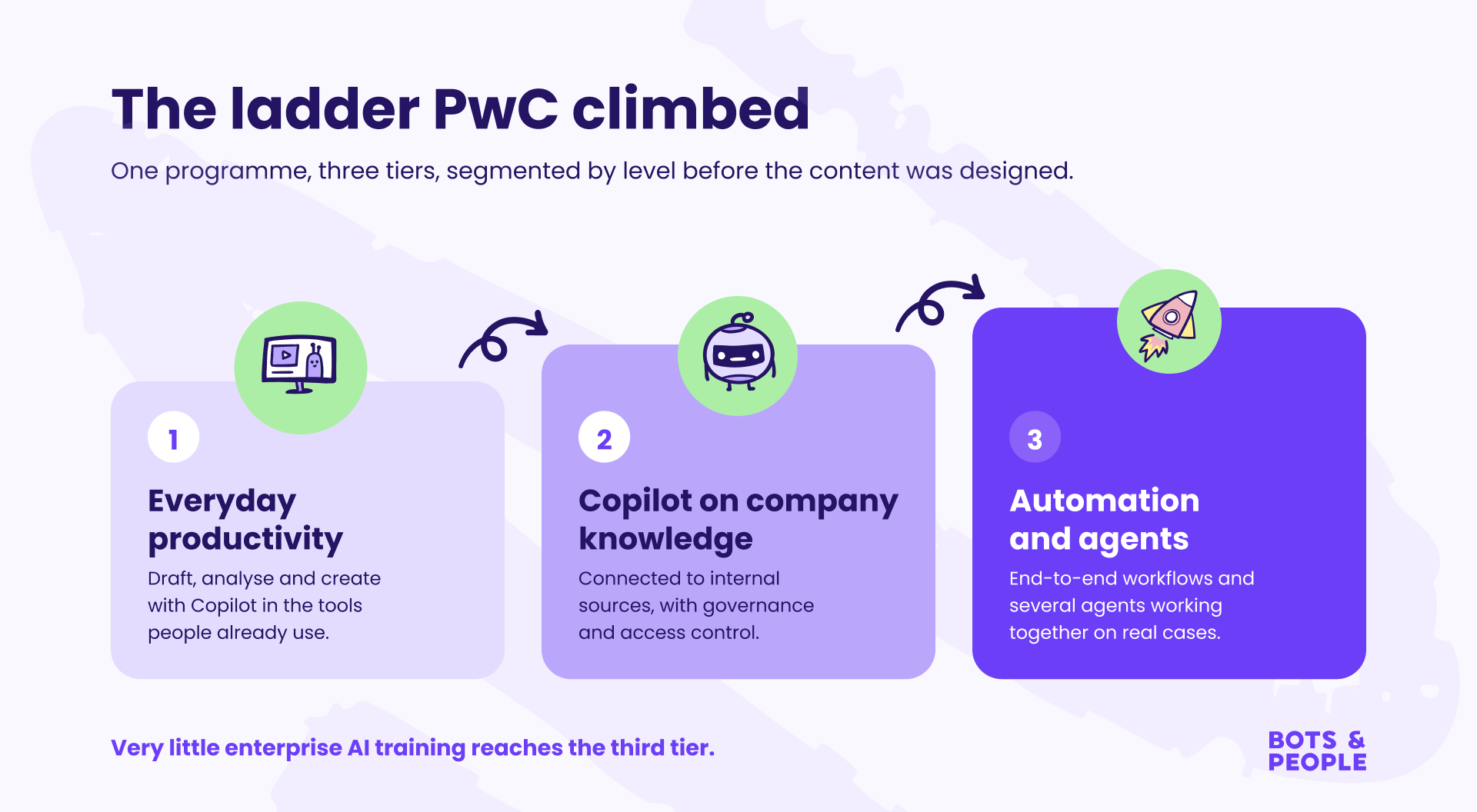
On that base, the programme was designed as a ladder of depth and segmented by level. Foundations went to the broad cohorts, and depth went to those ready for it. The path climbed in three clear tiers:
- Everyday productivity with Copilot. The starting point was using Copilot inside the tools people already have in front of them each day, to draft, analyse, and create faster. The goal here is confidence and habit, not sophistication.
- Copilot connected to the company's own knowledge. The next tier taught teams to connect Copilot to internal knowledge sources securely, applying data governance and access control. This is the step where AI stops being generic and starts answering with the real context of the business.
- Automation and agents. The advanced tier took the most prepared profiles into designing and optimising end-to-end automated workflows, and then into coordinating several agents working together on real business cases. Very little enterprise AI training reaches this far, and here participants asked to go further still.
One detail runs through all three tiers: the trainers worked directly on PwC's real use cases and tailored each session to the needs of each cohort. They also learned where to stay critical with AI and when to trust their own judgement. That closeness is what turns a demonstration of the tool into a skill people carry with them.
How much time did the business get back?
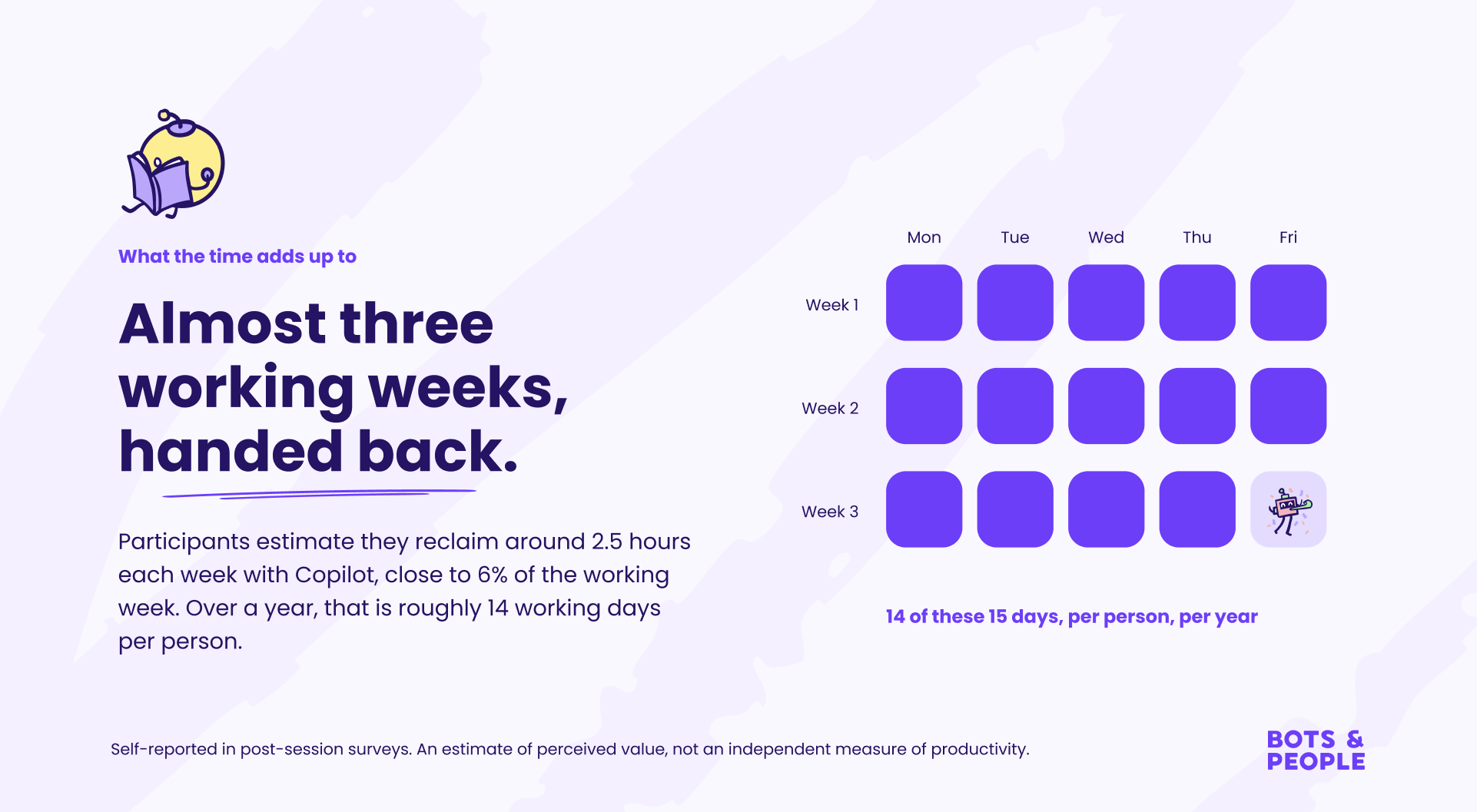
The most tangible impact of the programme is time. Before the training, much of the analysis, drafting, and document creation happened by hand. Afterwards, participants estimate they reclaim around two and a half hours of work each week with Copilot, which is close to 6% of their working week moving from manual tasks to higher-value work.
Seen across a year, that 6% adds up to nearly 14 working days per person, close to three working weeks handed back to each participant. The figure is self-reported in the post-session surveys, so it reads as an estimate of perceived value rather than an independent measurement of productivity. Even so, it is the kind of number a learning leader can take into a budget conversation.
Two further signals support the programme's credibility. Confidence to apply the learning landed above 85%, which is the closest a survey gets to knowing whether a skill survives contact with Monday morning. And trainers scored close to 90% across the whole journey.
The signal most case studies miss
The most persuasive number in this story is not a rating. It is the count of times PwC chose to book again. Several programmes across a single year, an advanced cohort segmented above the general training, function-specific tracks, and a volume that grew clearly year on year all point the same way.
A client that runs one training and stops is telling you something. A client that repeats it, segments its most advanced people, and asks what comes next is telling you something quite different. Repeat purchase at this scale is the enterprise version of a five-star review, because a firm the size of PwC does not renew budget for sessions its people quietly dislike.
The pipeline says the same thing. The agreed next step takes the learning into the field, in a format where the advanced profiles apply everything they have learned to real business challenges. This is an organisation moving from learning to doing.
Why did it work?
Three design choices did most of the work, and each one is portable to any learning leader planning an AI programme.
- Segment by level before designing the content. PwC did not put a new joiner and an advanced profile in the same room. When feedback dipped, it was almost always a level mismatch, which you fix by calibrating rather than by rebuilding the content.
- Practice over the lecture. The comments that recurred most often praised the breakout rooms, the live building with Copilot, and learning by doing, never a lecture to sit through.
- The ladder ran on Copilot because that is the tool PwC had deployed. What transferred was not the tool but the judgement of when to use it, and that judgement outlasts any single tool.
An AI tool without a trained user is a very expensive screensaver. PwC bought the tool, trained its people to use it properly, and the buying kept going. That is the whole case in one line.
What to do next
If you are planning AI adoption in your organisation and want a similar trajectory, these are the three decisions that matter most.
- Segment by level before you design anything. Identify who needs foundations and who is ready for advanced cases, then build separate tracks. Mixing them is the fastest way to lose both audiences.
- Commit to a ladder, not a one-off event. Plan the sequence from basic productivity with Copilot through to advanced application, so each session creates demand for the next.
- Measure confidence and perceived time saved, not only satisfaction. A satisfaction survey tells you the room was comfortable. Confidence to apply and time saved tell you whether the skill will get used.