Last updated August 19 2026 · 8 min read · By The Bots & People Team
Enterprise AI adoption is the work of moving an organisation from knowing that AI tools exist to using them confidently on real work, and it is the stage where most programmes quietly stall. AI awareness is easy to create, but the harder question is what happens when people actually want to go further. That is exactly what happened at Daimler Truck, and the way the company responded is a useful blueprint for anyone whose employees have moved past curiosity.
A generative AI awareness campaign reached more than 10,000 people, and among training participants, 97% asked for deeper generative AI training. They were not looking for another introduction to the technology; they wanted to understand how to use it in their actual jobs. With that, the challenge changed shape: it was no longer about creating awareness; it was about turning genuine appetite into practical capability.
TL;DR
- Daimler Truck reached over 10,000 people with AI awareness activities, and 97% of training participants then asked for deeper generative AI training, so the programmed shifted from awareness to building real capability and today, we have reached more than 20,000 particpants.
- Demand skewed towards the advanced end, with the agent's format drawing more responses than any other, which suggests employees are readier to build than most roadmaps assume.
- Rather than chasing a headline productivity number, the programmed focuses on helping people find real, meaningful uses for AI, and it is deliberately redesigned on the data as it comes in, which is what separates a serious adoption programmed from a one-off workshop.
What did we build together?
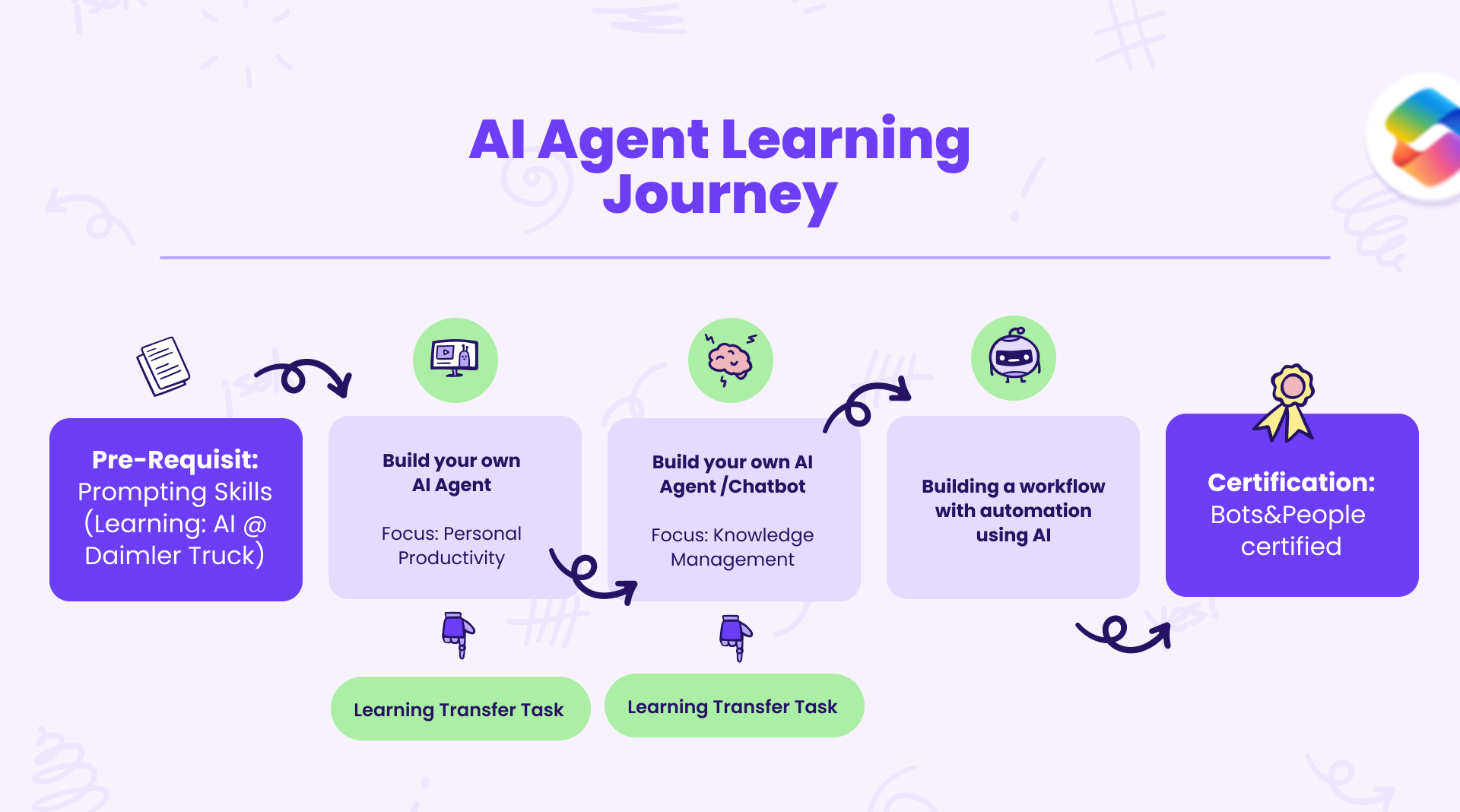
We built a clear path rather than a single course. Together with Daimler Truck, we designed the next phase around one idea: AI adoption should not stop at awareness. Employees need a visible route from understanding AI, to using it confidently, to eventually building with it, and the learning has to be designed as that whole journey rather than a one-off event.
The next phase was therefore structured as a capability journey from Beginner, to AI User, to AI Creator. Instead of relying on one generic course, the programme combines eight learning formats delivered in German and English, covering different skill levels, tools and use cases. For most employees the goal is to become confident AI Users who can apply advanced AI in their day-to-day work and start creating simple agents, while more advanced learners continue towards AI Creator skills, where they automate workflows, build more sophisticated agents and reshape how their teams work. This is what AI adoption looks like when learning becomes a system rather than a single workshop.
What surprised us most in the data?
We found that employees were far more ready than the usual assumptions allow. The clearest signal came from an unexpected place: the most popular part of the whole programme was learning to build AI agents. That topic drew 149 learner responses, more than any other we ran.
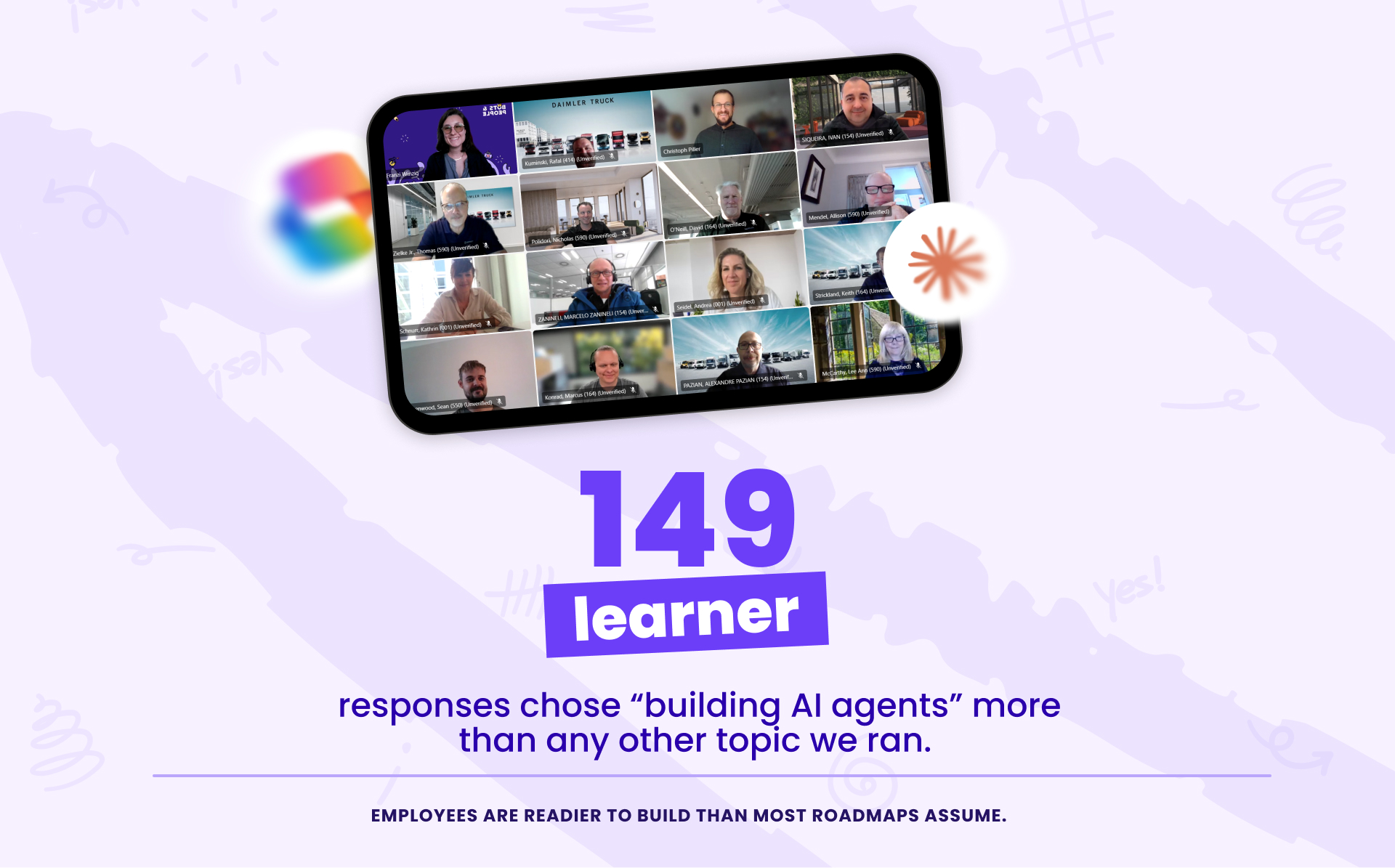
The common assumption is that people need to be eased into advanced AI slowly, starting with prompting, then introducing tools, and leaving agents for some later date. The Daimler Truck data points in a different direction, because when employees were given the chance to explore agents, the demand was already there. That reframes the question organisations should be asking. Rather than "are our employees ready for advanced AI?", the more useful question may be "are we giving them the right environment to learn how to use it?".
What changed for people in the programme?
Across the programme, learners began to recognise concrete places where AI could help them, and they left sessions more confident about using it in their own work. That shift, from watching AI to reaching for it, is the real early indicator that adoption is taking hold.
It also matters how that value is framed. This was never about doing the same work with fewer people. It was about freeing people from repetitive tasks so they can spend more time on work that actually needs their judgement. Employees adopt AI when they can connect it to something concrete in their day, whether that is a tedious task they can hand off, faster access to the information they need, or a problem they can now approach in a completely different way.
Where did we focus the learning?
We focused on putting people's hands on the tools. Learner feedback showed a very clear pattern in what participants valued most, led by peer exchange with 64 mentions, hands-on practice with 62 mentions, and trainer expertise and flexibility with 39 mentions. That reinforces one of the principles behind the programme, which is that people learn AI by using AI.
Understanding concepts still matters, but adoption happens when employees get the chance to test tools, work through real scenarios, exchange ideas with colleagues and connect what they are learning to their own work. For enterprise AI programmes, this changes how training has to be designed, because it cannot only be content delivery, it needs to create genuine space for experimentation.
What did we fix that most programmes miss?
We tackled the barrier that most teams never plan for, and it is rarely the AI itself. Once people had the tools in front of them, the harder part was not learning which button to press, it was working out where AI could genuinely help them. The support that made the biggest difference was guidance on finding and shaping meaningful use cases, so people were not just learning how a tool works, but how to spot a task worth improving and turn it into more valuable work.
That is a different skill from tool training, and it is where many AI programmes stop too early. Showing someone how to open an AI assistant is easy. Helping them see the handful of things in their week that AI could genuinely change, and then act on them, is the work that actually moves adoption. This is what we mean when we talk about AI capability: it is about creating more meaningful work, not simply operating a tool.
How do we keep improving it?
We keep improving it because AI moves too quickly for any programme to be designed once and left alone. Not every format performed equally well, and that turns out to be useful rather than a problem. Instead of presenting the programme as finished, the data is being used to decide what to improve. Some formats improved by half a point when they were delivered a second time, and the weakest-performing format was identified and is now being redesigned using learner feedback. For us, that measure-learn-adapt-and-run-again loop is what a serious adoption programme should look like.
What happens after awareness?
Daimler Truck has already answered the first important question, which is whether employees want to learn more about AI. With more than 10,000 people reached and 97% of training participants asking for deeper training, the demand is not in doubt. The more interesting question is what happens next, and the programme is now moving further into building and using AI agents, with tighter learner grouping, real Daimler Truck use cases, stronger preparation before sessions, internal champions and skill assessment.
The goal is not simply to train more people, it is to build an environment where employees can move from knowing about AI, to using AI, to building with AI. That is the difference between AI awareness and AI capability, and ultimately it is the difference between having AI tools inside an organisation and actually making them work for people. An AI tool without a trained user is, after all, a very expensive screensaver.
How we can do this with you
If your organisation has already introduced AI, your next challenge may not be awareness at all. Your employees may already be curious, they may already be experimenting, and they may be ready to go much further than your current learning programme allows. The real question is whether you have a system in place to convert that demand into capability.
That is the work we do with organisations, from AI skill assessment and structured learning journeys to hands-on training, agents, real use cases and adoption programmes designed around actual work. If your people are past curiosity, we can help you build the system that turns it into capability.