TL;DR
- A single AI maturity number hides more than it reveals, so Bots & People scores AI readiness across four equally weighted dimensions, which shows where an organisation is genuinely strong and where it is quietly stuck.
- Most enterprises over-invest in one dimension, usually licenses bought as a proxy for progress, while ignoring the dimension that is actually holding them back, which is one reason 88% of organisations now use AI but only 6% capture significant value (McKinsey, 2025).
- The fastest way to lift an AI rollout is to find your lowest of the four dimensions and fix that one first, which the four-minute AI Readiness Check surfaces as a 0–100 score.
Most AI readiness assessments give leaders one number and call it a verdict. That number feels reassuring in a board deck and tells you almost nothing about what to do on Monday. A company can buy Copilot licenses at scale and still see barely any of them used in real work, because the license count measures spend, not capability. This article explains what each dimension measures, the proof behind it, and how to read the four together so your next budget decision fixes the right gap rather than the loudest one.
Why isn't AI readiness a single score?
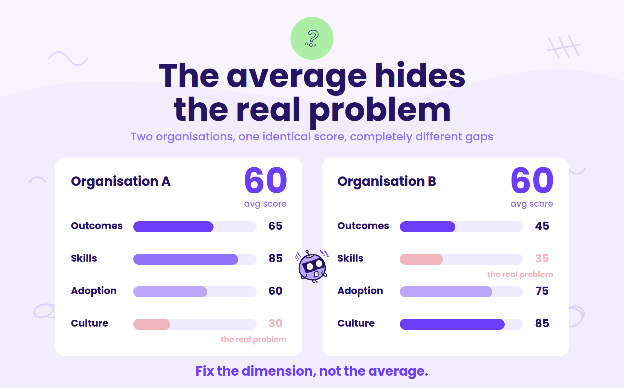
A single score fails because it averages the one dimension that is breaking your rollout. Two organisations can both score 60 out of 100 while being in completely different trouble: one has trained people and no leadership backing, the other has enthusiastic executives and a workforce that has never been shown how to use the tools. The four dimensions keep those cases distinct.
Bots & People weights all four dimensions equally, on purpose. Most vendor maturity models measure the technology they sell model access, license penetration, infrastructure. We measure the people who must use it, because that is where value is created or lost. An AI tool without a trained user is a very expensive screensaver, and no amount of platform sophistication changes that. The four dimensions are Outcomes, Skills, Adoption and Culture, and a strong overall score only means something when all four are strong together.
Dimension 1, Outcomes: Is AI actually saving time and money?
Outcomes measure whether AI is producing results you can put in front of a CFO: hours saved, cycle times cut, quality improved, cost avoided. This is the dimension boards care about most and the one that is easiest to fake with anecdotes, so it needs hard numbers rather than testimonials.
The benchmark here comes from work with Deutsche Telekom, where structured upskilling produced 1.9 hours saved per employee per day, at a training NPS of 59. The hours matter more than the satisfaction score, because saved time is what compounds into capacity. When Outcomes is your weakest dimension, the usual cause is that people are using AI for low-value tasks such as tidying an email or summarising a meeting, rather than the work that actually moves a number. Fixing Outcomes is less about more tools and more about pointingexisting skills at higher-value tasks. For a fuller treatment of measurement, see the enterprise AI upskilling playbook, which sets out the full success-metrics framework this dimension draws on.
Dimension 2, Skills: Can your people use AI, and does it satisfy Article 4?
Skills measure whether employees can apply AI safely and productively in their actual roles, from prompting fundamentals to knowing what not to trust. It is the dimension most exposed to regulation, and the deadline is now close.
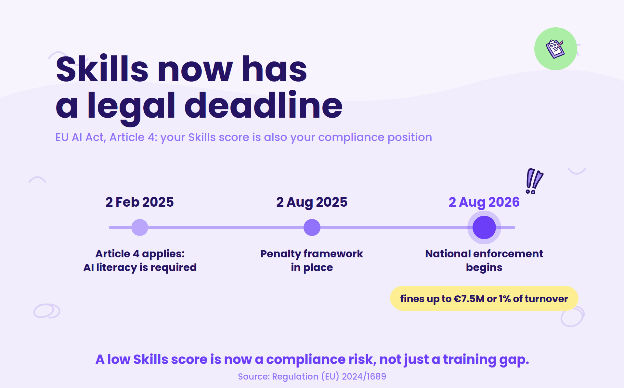
The gap is well documented. McKinsey's 2025 State of AI survey found that 88% of organisations regularly use AI in at least one business function, yet only 6% capture significant enterprise-wide value (McKinsey, 2025). Access is no longer the constraint; capability is. On top of that, Article 4 of the EU AI Act has required a "sufficient level of AI literacy" among staff since 2 February 2025, and national authorities gain formal powers to enforce it from 2 August 2026, with breaches sitting in a penalty tier of up to €7.5 million or 1% of global annual turnover. For DACH enterprises that treated literacy as optional, Skills has quietly become the dimension with legal teeth. The five-level competency model in the 5 levels of AI competence gives you a way to grade where each team currently sits.
Dimension 3, Adoption: how many people use AI on real work, not just once?
Adoption measures sustained use on genuine tasks, not first-day curiosity. The honest question is not how many licenses you hold, but what share of licensed users touched AI on real work last week and kept doing so.
This is where the licenses-bought-versus-people-using gap becomes visible. In a gamified programmed with Daimler Truck, structured training and internal competition lifted Copilot Chat adoption by 85% over six months across 33 countries, precisely because it made repeated, real use the point rather than a one-off login. When Adoption lags, the pattern is almost always the same: a kickoff email, a short spike, then silence. Treating a rollout like a product launch with ongoing enablement, rather than an IT provisioning task, is what keeps the curve from collapsing. The mechanics of that gamified format are covered in the write-up of how the AI Contest reached 85% adoption at Daimler Truck.
Dimension 4, Culture: does leadership actually champion AI?
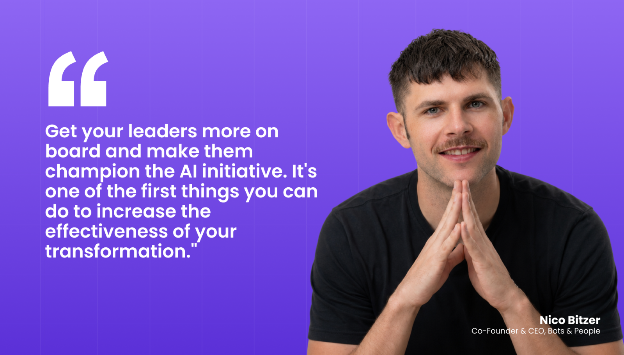
Culture measures whether senior leaders visibly use and sponsor AI, and whether the organisation treats learning it as normal rather than risky. It is the dimension enterprises ignore most, and the one with the largest multiplier on the other three.
The evidence is blunt. BCG's Build for the Future 2025 research found that AI future-built companies achieve roughly five times the revenue increases and three times the cost reductions of their peers, and that the playbook to get there starts with a strong, explicit commitment from top management (BCG, 2025). BCG's 2026 analysis reaches the same conclusion from another angle: the biggest single differentiator of AI leaders is developing talent across the organisation, not hiring a few specialists. Adoption follows the top. When executives delegate AI entirely to a project team and never use it themselves, employees read that signal correctly and treat training as theatre.
How to use the four dimensions: find your weakest, fix it first
Read the four scores as a diagnosis, not a grade. The single most useful move is to identify your lowest dimension and direct the next quarter's budget there, because the lowest score is the ceiling on the other three. High Skills with low Culture produces trained people who quietly stop using AI. High Adoption with low Outcomes produces lots of activity aimed at trivial tasks.
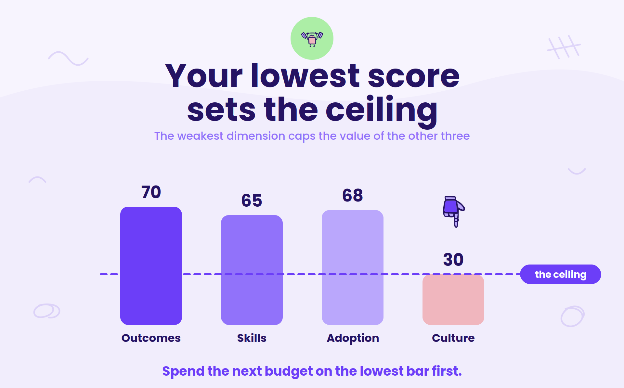
A worked example makes it concrete. An organisation scoring Outcomes 70, Skills 65, Adoption 68 and Culture 30 does not have a "60 out of 100" problem; it has a leadership problem wearing a decent average. Pouring more training into that company would lift Skills and change nothing, because Culture is the constraint. The AI Readiness Check returns all four scores plus the combined 0–100 number in about four minutes, so the weakest dimension is obvious before your next budget round rather than after it.
What to do next
- Take the four-minute AI Readiness Check and note your lowest dimension, not just your headline score.
- Compare licenses held against weekly active users on real tasks; if the gap is large, your problem is Adoption, not tooling.
- Before 2 August 2026, confirm that you can document a "sufficient level of AI literacy" for staff using AI, so the Skills dimension also covers your Article 4 position.
- If Culture is your lowest score, put one senior leader on record using AI in their own work before you spend anything more on training.
- Read the enterprise AI upskilling playbook for the full framework these four dimensions sit inside.
Frequently Asked Questions
What are the four dimensions of AI readiness?
The four dimensions are Outcomes, Skills, Adoption, and Culture. Outcomes cover the business value AI produces, Skills covers whether employees can use it, Adoption covers sustained real-world use, and Culture covers leadership sponsorship. Bots & People weights all four equally and combines them into a single 0–100 readiness score.
How is AI readiness different from AI maturity?
Readiness describes your organisation's current capacity to turn AI into value across the four dimensions right now. Maturity usually describes a longer arc of stages an organisation moves through over time. The two are related, and the five stages of organisational AI maturity explains how a readiness score maps onto a maturity stage.
What counts as a good AI readiness score?
There is no universal pass mark, because a strong average can still hide one weak dimension. A score of 70 spread evenly across all four dimensions is far healthier than 70 built on three strong dimensions and one near zero. The most useful signal is your lowest dimension, since it caps how much value the others can deliver.
How do you measure the Culture dimension?
Culture is measured through visible leadership behaviour and organisational signals: whether executives use AI themselves, whether AI sponsorship is named and owned rather than delegated, and whether employees feel safe learning in work hours. BCG's research links exactly this kind of top-management commitment to five times higher revenue gains from AI (BCG, 2025).
Does the EU AI Act require an AI readiness assessment?
The EU AI Act does not require an assessment by name, but Article 4 requires providers and deployers to ensure sufficient AI literacy among staff, and that obligation becomes enforceable from 2 August 2026. A readiness assessment that scores the Skills dimension gives you documented evidence of the measures you have taken, which is what regulators will look for.
Related articles
- Enterprise AI Upskilling: The Complete 2026 Playbook: the cornerstone this article supports
- The 5 Levels of AI Competence: how to grade the Skills dimension
- The Five Stages of Organisational AI Maturity: how readiness maps to maturity