Last updated August 2026 · 6 min read · By Nico Bitzer, Co-Founder & CEO, Bots & People
An L&D AI strategy is the plan a learning function owns for building AI capability across the workforce defined, funded and launched before the business formally asks for it.
TL;DR
- L&D teams that wait for a business request on AI arrive 12 to 18 months late, because generative AI tools change faster than an annual training cycle can absorb.
- When L&D stays quiet, someone else fills the vacuum: strategy consultancies, IT-run lunch-and-learns, or a Slack channel full of forwarded YouTube links that nobody calls a curriculum.
- A working L&D AI strategy starts with measurement across four dimensions (Outcomes, Skills, Adoption, Culture), launches a minimum viable programme fast, and reports adoption numbers rather than completion rates.
At LearnTec 2025 in Karlsruhe I had a conversation that has stayed with me ever since. I was talking to an L&D leader from a large automotive supplier, experienced, senior, clearly sharp. I asked what his team was doing on AI upskilling, and he told me they would wait until the business told them to act. That single sentence explains most of what has gone wrong with corporate AI adoption in the DACH region. This article is about why the reactive posture fails, who takes the mandate when L&D declines it, and what a proactive strategy looks like in practice.
Why does "we'll wait until the business tells us" fail?
Waiting fails because the request arrives too late to act on. By the time a business unit formally asks L&D for AI training, the tools have moved through two or three release cycles, the shadow usage is already established, and the expectation is delivery in weeks rather than the six months a traditional programme design takes.
I understand the logic behind the waiting. Learning departments have been structured as service functions for decades: the business says it needs a leadership programme, and L&D builds one. That model works when the underlying skill is stable, and leadership development has been stable for thirty years.
Generative AI breaks the model because the half-life of the knowledge is 6 to 18 months. Microsoft ships a Copilot update on a Tuesday, and a workshop built around last quarter's interface is already partly wrong. A department that begins scoping only after the request lands is structurally 12 to 18 months behind the tools its people are already using.
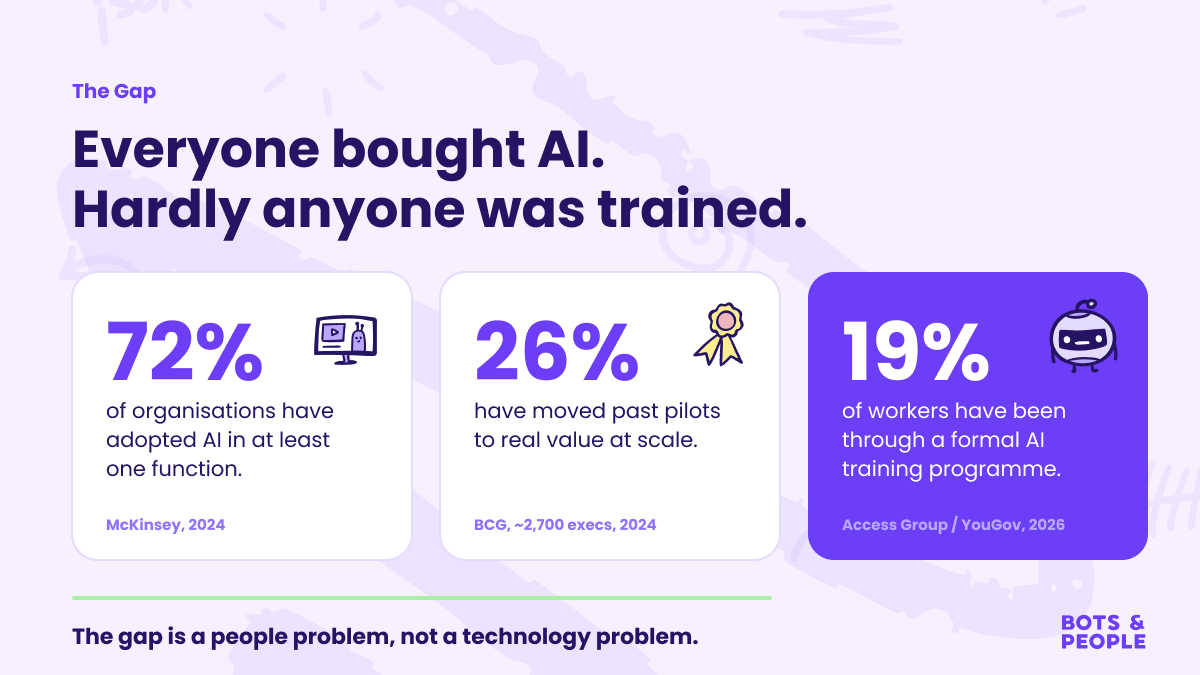
The scale of the mismatch is documented. McKinsey found that 72% of organisations had adopted AI in at least one function (McKinsey, State of AI, 2024), while BCG's survey of roughly 2,700 executives found that only 26% had moved past pilots to real value at scale (BCG Henderson Institute, 2024). The gap between those two numbers is a people problem, not a technology problem, and the people problem sits inside L&D's remit whether or not anyone has sent the email.
Who owns AI upskilling when L&D stays quiet?
Nobody owns it cleanly, which is the actual danger. In every large organisation I have worked with, the AI adoption puzzle is split across three roles that barely coordinate: the CHRO and C-Suite, the CIO or Head of Digital, and the Head of L&D. When the third seat stays empty, the work does not stop it gets redistributed badly.
Here is what the redistribution looks like in practice:
- The C-Suite hires a consultancy. Board-level pressure produces a strategy deck and a lighthouse project, and neither of those changes what 20,000 people do on a Monday morning.
- IT runs the enablement. The tools get deployed and the dashboards show licence utilisation, but a dashboard can tell you that someone opened Copilot on Tuesday, not whether they knew what to do once it was open.
- Employees train themselves, invisibly. Research from The Access Group and YouGov, reported by HR Grapevine in 2026, found that fewer than one in five workers (19%) have been through a formal AI training programme. The rest are experimenting alone, with whatever habits that produces.
Ethan Mollick, professor at the Wharton School, calls these self-taught employees secret cyborgs, and his point about surfacing them is the relevant one for learning teams. <a href="https://www.insightpartners.com/ideas/ethan-mollick-on-ai/">"Your secret cyborgs come out of your crowd,"</a> he told Insight Partners in November 2025, adding that leadership has to actively incentivise those people to come forward.
Somebody in your organisation is already three months ahead of your training plan, and right now you have no mechanism to find them, verify what they are doing, or scale it. Building that mechanism is a learning function's job. It is not a support task, and it is not something IT can do with a licence report.
What does the EU AI Act change for L&D in 2026?
Article 4 of the EU AI Act has applied since 2 February 2025 and requires providers and deployers of AI systems to take measures supporting AI literacy among staff and anyone operating those systems on their behalf. The Digital Omnibus on AI, in force since mid-July 2026, softened the wording from ensuring a sufficient level to supporting the development of AI literacy.
Two things follow for a learning function. First, the obligation is contextual rather than numeric: the European Commission's guidance on AI literacy sets no minimum training hours and no certificate standard, so the burden is on the organisation to show that its people are actually capable relative to the systems they operate. Second, there is currently no standalone fine attached to Article 4, though market surveillance authorities can weigh literacy measures when they investigate other violations. You can read the full text of Article 4 in a few minutes.
A requirement to prove capability, with no prescribed format, is a measurement problem before it is a training problem. Course completion records will not answer it, because completing a module is evidence of attendance rather than evidence of competence. Neither will a policy PDF on SharePoint.
This is the part where waiting becomes genuinely expensive. When legal or compliance eventually asks how the organisation demonstrates AI literacy, the answer needs to already exist. Building the evidence base takes a quarter or two, and it cannot be produced retroactively for a workforce that was never assessed.
What does a proactive L&D AI strategy look like in practice?
A proactive strategy measures before it trains, launches something small and imperfect within one quarter, and structures capability in three stages rather than a static course catalogue. The sequence matters more than the content, because a programme designed without baseline data is a guess with a budget attached.
The structure we use across roughly 80,000 trained employees breaks into three stages:
- Understand: for everyone. A shared foundation covering what generative AI is, which tools the company offers, and what the AI Act means for an individual employee. Fifteen minutes of e-learning or a 60-minute webinar is enough, because the purpose is permission rather than mastery.
- Use: for every department. This is where the measurable efficiency appears, and it has to be built on the department's real data: a procurement workshop uses procurement data, a marketing workshop uses marketing copy.
- Build : for your AI champions. The 5 to 10% in every department who are ready to go beyond using AI into building with it, through custom GPTs, Copilot Studio agents and automated workflows.
Measurement runs across four dimensions with equal weight: Outcomes (did the numbers change), Skills (what can people do tomorrow morning), Adoption (is anyone using it on a Monday), and Culture (can people try things without being punished). At Daimler Truck, that loop produced 20,000 participations across six countries and an 85% increase in Copilot Chat usage an adoption number, not a completion number. At Deutsche Telekom, 18,000 trained employees reported average time savings of 1.9 hours per employee per day, at an NPS of 59.
Notice what those two numbers have in common. Both describe behaviour that changed, which is the only kind of result a board will fund twice.
How does L&D earn a seat at the table with IT and the board?
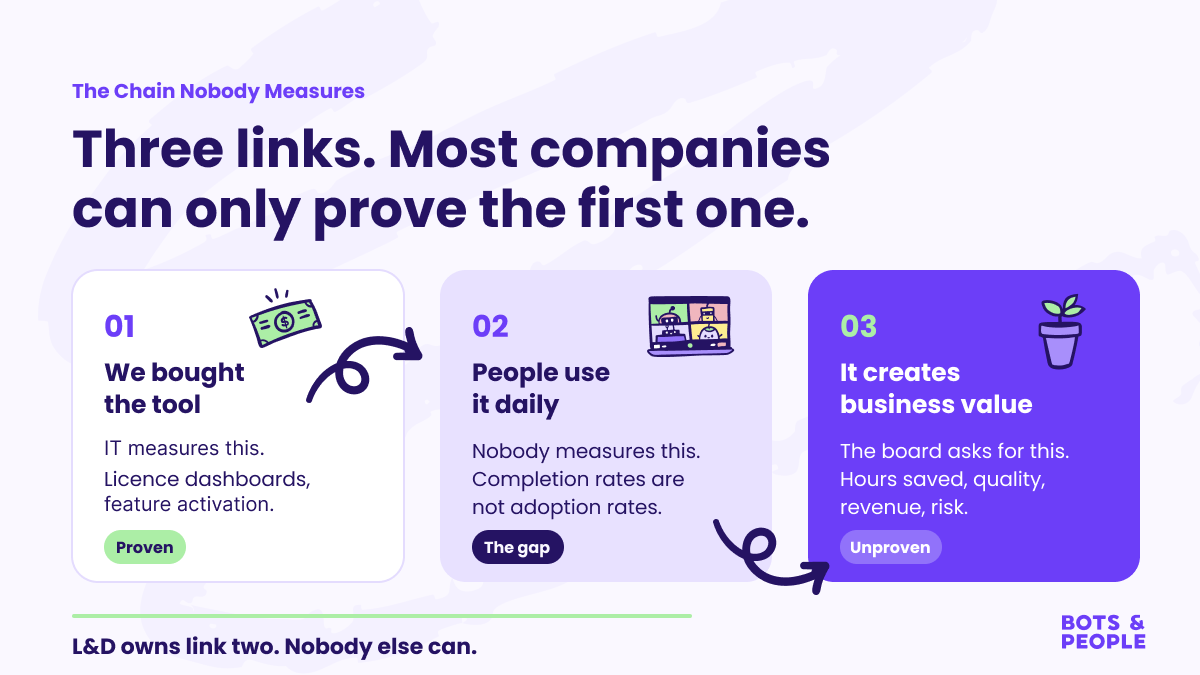
L&D earns the seat by arriving with a number rather than a request. IT measures deployment, L&D traditionally measures satisfaction, and the C-Suite measures strategic KPIs, so nobody currently reports the full chain from purchase to habit to business value. The function that reports that chain becomes the owner of it.
The chain has three links, and each one needs a figure attached: we bought the tool, people use it daily, and it creates business value. Most organisations can evidence the first link from a licence dashboard and almost none can evidence the third.
There is a supporting problem worth naming, because it decides whether any of this survives contact with the org chart. LinkedIn's 2025 Workplace Learning Report found that 50% of organisations say their managers lack proper support, and middle management is exactly where AI adoption is either normalised or quietly ignored. When a manager visibly uses AI in front of their team, the team follows in a way no launch email achieves, so manager enablement belongs in the strategy rather than in a later phase.
An AI tool without a trained user is a very expensive screensaver. The learning function is the only part of the organisation that can change that, and it does not need permission to start.
What to do next
- Run a baseline assessment this quarter across Outcomes, Skills, Adoption and Culture, and survey employees rather than only executives the gap between the two answers is the most useful signal you will get.
- Ship a minimum viable programme within 90 days, even if it covers one department and 200 people, because a real pilot generates better design input than another round of stakeholder alignment.
- Identify your 5 to 10% enthusiasts by name in every department, give them advanced training and a stage, and let them pull colleagues forward.
- Replace completion rates with adoption rates in your reporting to IT and the board, and use a time-bounded behavioural question such as how many times someone opened an AI tool for a work task in the past five working days.
- Document your AI literacy evidence now so that the Article 4 answer exists before anyone asks for it.