Last updated August 2026 · 8 min read · By The Bots & People Team
An enterprise AI agent is software that can pursue a goal across several steps, making decisions and taking actions on its own, rather than waiting for a prompt the way a chatbot or a copilot does.
TL;DR
- Adopting AI agents is now nearly universal in intent but rare in practice: around three-quarters of enterprises report adopting agentic AI, yet only about 11 to 17 percent run agents in genuine production (Forrester, Gartner and Deloitte, 2026).
- The projects that die rarely die because the model could not do the work: Gartner expects over 40 percent of agentic AI projects to be cancelled by the end of 2027 on escalating cost, unclear business value and weak governance.
- What separates the few that scale is not a better platform but the capability to build, integrate and supervise agents, a Build-level workforce and governance discipline that most organisations have not yet developed.
Every board deck in 2026 has an agent slide, and very few of those agents are running in production. The distance between the ambition on the slide and the reality in operations has become the real story of enterprise AI this year. This article explains what an agent actually is, why so many agentic projects stall before production, what the organisations that succeed do differently, and why the deciding factor is your people rather than your platform.
What is an enterprise AI agent, and what is "agent washing"?
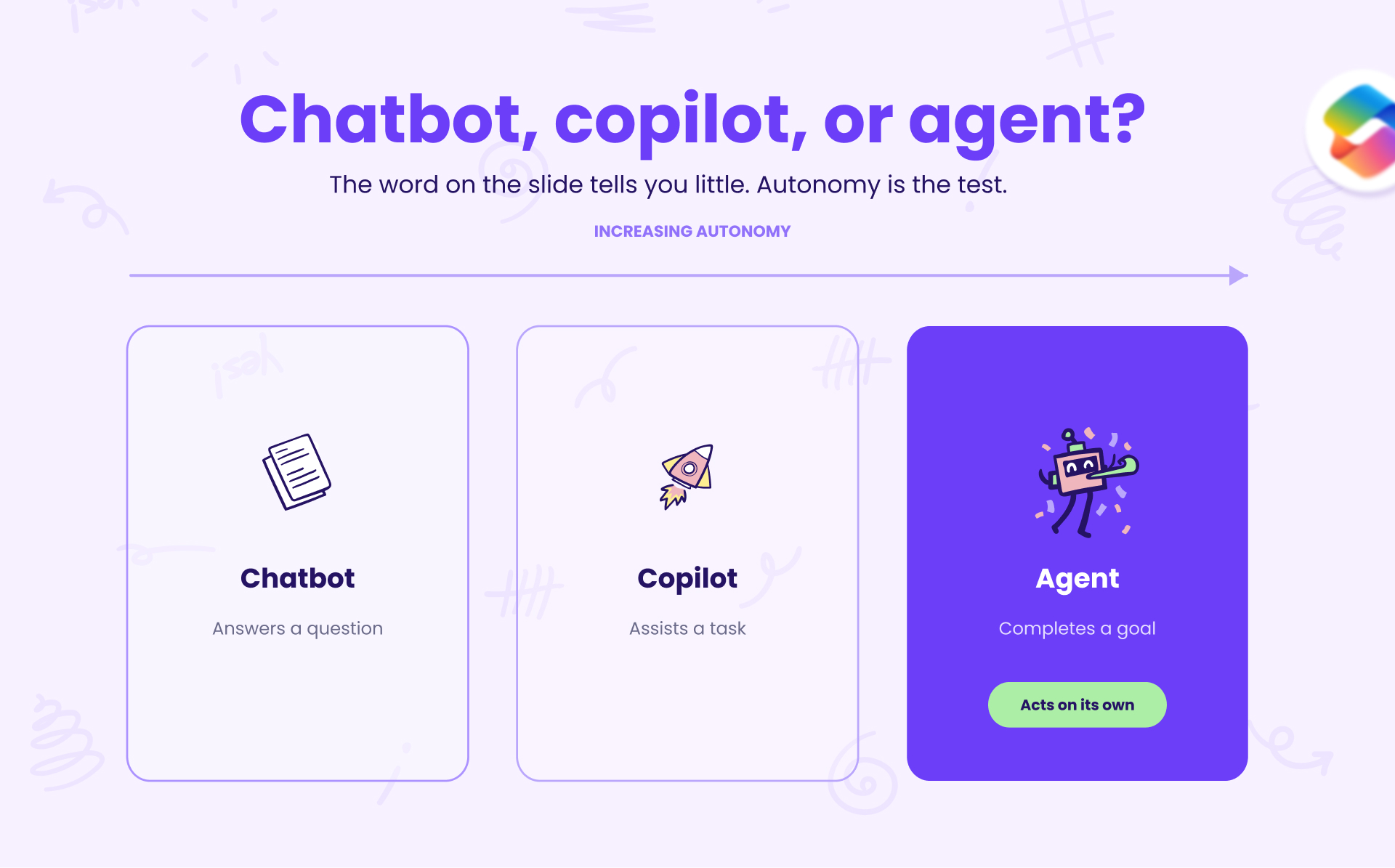
An enterprise AI agent is software that pursues a goal over multiple steps, chooses its own actions, and uses connected tools or systems to reach the outcome. A chatbot answers a question, a copilot assists a person with a task, and an agent completes a goal with limited human intervention. "Agent washing" is the practice of rebranding older tools as agents without the autonomy that defines them.
Gartner has warned that much of the market is agent washing: of the thousands of vendors claiming agentic capability, the firm estimates only around 130 are building something that deserves the label (Gartner, 2025). The practical consequence for a buyer is that the word "agent" on a slide tells you very little on its own. Before any budget conversation, one plain question does most of the work: does this system decide and act across steps, or does it retrieve and suggest while a person does the deciding? The two need different governance, different cost models, and different skills from the people around them.
Why are AI agents everywhere in pilots but rare in production?
Adoption intent is nearly universal while production remains rare. Around three-quarters of enterprise leaders report adopting agentic AI, yet only about 11 to 17 percent run agents in genuine production, depending on the survey (Forrester, Gartner and Deloitte, 2026). The demo works, the pilot works, and then the project stops short of live operations.
Gartner's 2026 reading puts roughly 17 percent of organisations at the point of having deployed agents, while more than 60 percent expect to within two years, which sets up a wide intent-to-deployment gap. Anushree Verma, Senior Director Analyst at Gartner, has described most of today's agentic work as "mostly driven by hype and are often misapplied." The pattern behind the numbers is consistent: a convincing proof of concept earns a budget, the budget produces a pilot, and the pilot then meets the messier reality of production data, systems integration and accountability. Organisations that treat that transition as an IT provisioning task rather than an operating change tend to be the ones whose agents never leave the lab.
Why do agentic projects get cancelled? Cost, value and governance
Gartner expects over 40 percent of agentic AI projects to be cancelled by the end of 2027, and points to three causes: escalating cost, unclear business value, and inadequate risk controls (Gartner, 2025). Very few of those cancellations trace back to a model that could not do the work.
Cost is the quiet killer. EY has put the price of a simple 2023 chatbot call at roughly $0.04 and a 2026 orchestrated agent interaction at about $1.20, close to thirty times higher (EY, 2026), and most of that only becomes visible once real production traffic arrives. Governance is the other structural problem. A separate Gartner forecast expects 40 percent of enterprises to demote or decommission autonomous agents by 2027 after governance gaps surface in live incidents, and only around 21 percent of organisations report a mature governance model today. As Forbes summarised the pattern, these are management failures rather than model failures (Forbes, 2026): an agent takes an action nobody scoped, and switching it off becomes the safest response available.

What separates the organisations that actually scale agents?
The organisations that scale agents are rarely the ones with the most advanced platform. They redesign the workflow around the agent, choose use cases with provable value, build governance in from the start, and invest in the people who operate the system. The platform is seldom the deciding variable.
A useful discipline, drawn from Gartner's own guidance, is to match the tool to the job: use an agent when a decision has to be made and acted on, use automation for routine repeatable workflows, and use an assistant for simple retrieval. Applying an agent to a problem that a scripted automation would solve more cheaply is one of the fastest routes to the cancellation column. The organisations that get this right also treat measurement seriously, defining the business metric an agent is meant to move before it ships, so the value is demonstrable rather than assumed. None of that is a purchasing decision. It is an operating capability, and it lives in the people who scope, build and supervise the agents.
The real bottleneck is a workforce that can build and supervise agents
The scarce resource in 2026 is not agent software but people who can build, integrate and oversee agents safely. In the Bots & People competence model, that work sits at the Integrate and Build levels, while most organisations still have the bulk of their workforce at the Discover and Understand levels.
An agent that acts on its own needs two kinds of human capability around it. A small group has to design, build and connect agents to real workflows, which is Build-level work: scoping a use case, wiring the agent to internal systems, defining the metrics it will be judged on, and producing a deployment plan a department can run. A much wider group has to supervise agents responsibly, which means recognising when an output cannot be trusted, knowing where a human decision is still required, and applying the company's guardrails. Bots & People develops the first group through formats such as the AI Agent Builder journey and agent-building workshops, and the second through role-specific enablement that reaches the whole workforce. You can see how these map onto the wider levels of AI competence and the enterprise AI upskilling framework that surrounds them.

What to do next
Before committing more budget to agents, do the foundation work that separates the projects that ship from the projects that get cancelled. Five moves make most of the difference:
- Start with decision-heavy use cases where an agent genuinely beats an assistant or a scripted automation, and drop the ones chosen for their demo value.
- Model the production cost, not the pilot cost, since orchestrated agent interactions can run close to thirty times a simple chatbot call (EY, 2026).
- Put oversight and accountability in place before you scale, so an agent cannot take an unscoped action without a human able to catch it.
- Build the Build-level capability inside the business rather than buying another platform, and pair it with agent-supervision skills for the wider workforce.
- Check where your organisation actually stands before the next budget round: the four-minute AI Readiness Check scores the skills and governance dimensions that decide whether an agent reaches production.
For the full picture of how this capability is built at scale, the enterprise AI upskilling playbook sets out the framework these steps sit inside, and The Four Dimensions of AI Readiness shows how skills and governance combine into a single readiness score.
Frequently Asked Questions
What is an enterprise AI agent?
An enterprise AI agent is software that pursues a defined goal across several steps, makes its own decisions along the way, and takes actions through connected tools and systems. Unlike a chatbot, which responds to a single prompt, or a copilot, which assists a person with a task, an agent is designed to complete the task with limited human intervention while staying inside defined guardrails.
What is the difference between an AI agent and a chatbot or copilot?
A chatbot answers questions, a copilot helps a person do a task faster, and an agent completes a goal on its own by planning steps and acting on them. The practical test is autonomy: if a human still makes and executes each decision, the system is an assistant rather than an agent, whatever the label on the slide claims.
Why do most AI agent projects fail?
Most fail on cost, unclear business value or weak governance rather than model capability. Gartner expects over 40 percent of agentic projects to be cancelled by the end of 2027. Production costs that were invisible at pilot stage, use cases chosen for their demo appeal, and oversight added too late are the recurring reasons a project stalls before it reaches live operations.
What skills does a team need to deploy AI agents?
Two capabilities matter. A small group needs Build-level skills to scope, build, integrate and measure agents, and a much wider group needs to supervise agents responsibly by spotting untrustworthy outputs, knowing when a human must decide, and applying company guardrails. Most organisations have neither in enough depth, which is why capability, not software, is the true constraint on scaling agents.
Do AI agents fall under the EU AI Act?
Agents are governed by the same rules as other AI systems, so their risk classification depends on how they are used, and higher-risk uses carry stricter obligations. Article 4 of the EU AI Act also requires a sufficient level of AI literacy among staff who use AI, and that duty became enforceable on 2 August 2026 (EU AI Act, Article 4). Agent-supervision skills form part of meeting it.
The Bots & People Team.