Enterprise AI Upskilling: The complete 2026 Playbook
Last updated June 2026 · 30 min read · By Bots & People
Enterprise AI upskilling is the structured process of building generative AI capability across an organisation, moving employees from simply knowing that tools like Microsoft Copilot exist to using them confidently in their daily work.
TL;DR
- Enterprise AI upskilling is what now separates the organisations getting value from AI from the roughly 6% that report significant impact, because adoption has become near-universal while real results stay rare (McKinsey, 2025).
- The organisations that succeed measure four things before they train (Outcomes, Skills, Adoption and Culture), then they run training as a quarterly loop rather than a one-off launch, because completion rates measure attendance, not behaviour change.
- Bots & People structures upskilling around a five-level model (Discover → Understand → Use → Integrate → Build) delivered through three rollout stages, an approach refined across 80,000+ employees at Deutsche Telekom, Daimler Truck and Siemens Energy.
Bots & People is a Berlin company that has trained more than 80,000 people across 30-plus enterprises in the DACH region. This playbook is the argument the team makes to L&D leaders almost every week: the technology is no longer the hard part, the people side is, and there is a concrete way to do it well. What follows is the whole chain, from why most programmes stall to how you measure, structure and roll out something that actually changes how people work.
What is enterprise AI upskilling?
Enterprise AI upskilling is the structured, organisation-wide effort to take every employee from "I have heard of ChatGPT" to using AI confidently and safely in their actual job. It is not a content library or a single webinar. It is a multi-stage process that changes how people work, and it is measured by behaviour rather than by course completions.
There is a line worth repeating: an AI tool without a trained user is a very expensive screensaver. Nobody has proven it wrong yet. A Microsoft Copilot licence that gets opened twice and then ignored costs exactly the same as a Copilot licence that saves someone an hour a day. The difference is never the software. The difference is whether the person knows what to do once the cursor is blinking.
Most organisations still treat this as procurement. They buy the licences, send the all-staff email, run a lunch-and-learn, and build a SharePoint page with some links, and then they wait for productivity to appear. It rarely does, because buying access and building AI literacy across a workforce are two completely different projects, and only one of them shows up on the invoice. Enterprise AI upskilling is the second project.
Why does most enterprise AI upskilling fail?
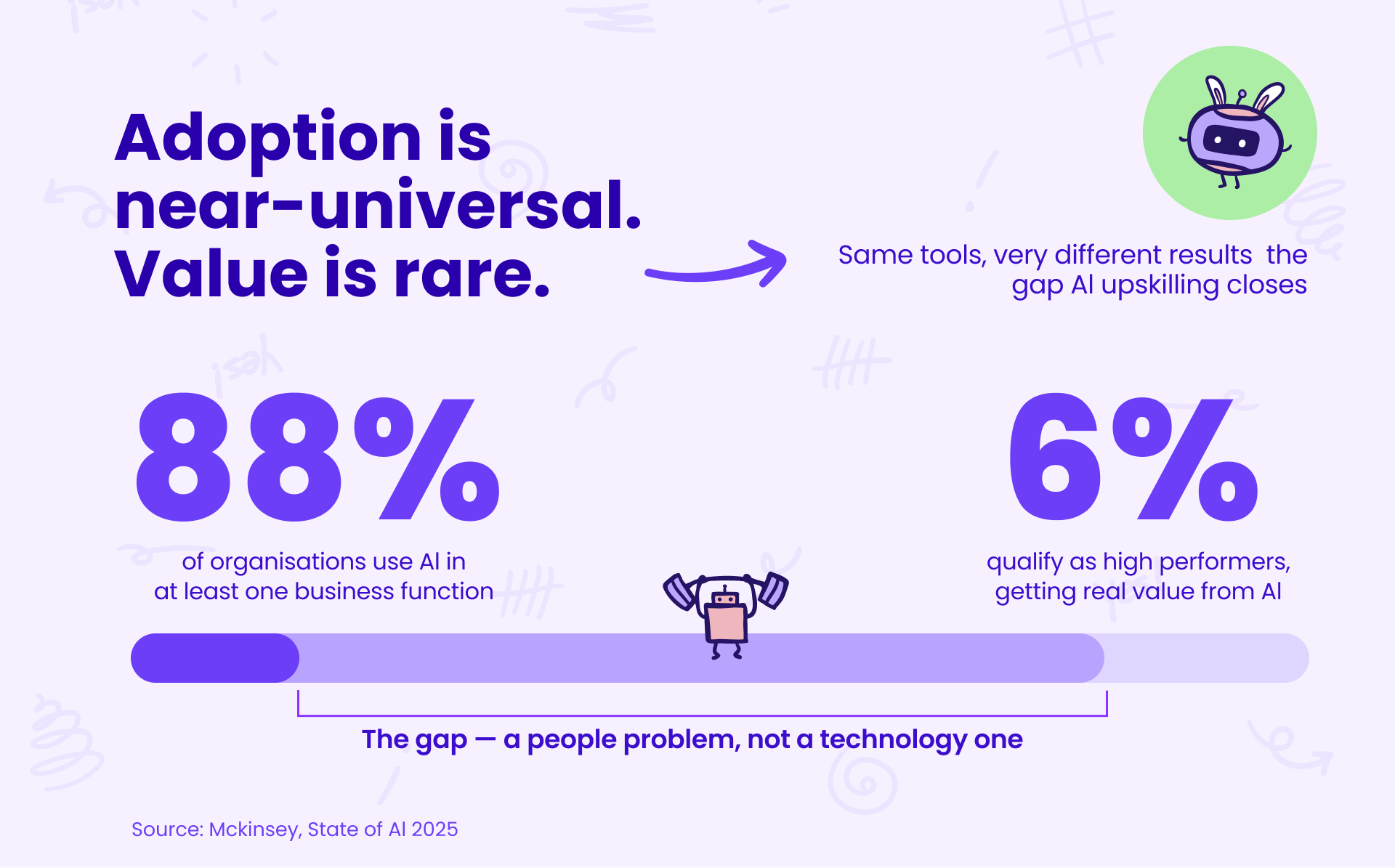
Most enterprise AI upskilling fails because organisations measure the wrong thing. They track licences deployed and courses completed, not whether anyone works differently on a Monday morning. Adoption is now near-universal, but value stays rare, and the gap between the two is a people problem rather than a technology one.
The headline numbers make it look like the war is already won. McKinsey's State of AI 2025 found that 88% of organisations now use AI in at least one business function, up from 72% a year earlier (McKinsey, 2025). Then you read the same report more carefully. Only around 6% qualify as high performers who attribute more than 5% of EBIT to AI, and only about 7% have fully scaled it across the organisation. BCG tells the same story from another angle, with just 26% of companies moving past pilots to value at scale (BCG, 2024). So the real number is not 88%. The number that reflects people doing something different because of AI is much smaller, and that gap between what organisations have bought and what their people can do with it is the whole problem.
Three things keep widening it.
The first is that the official tools sit unused while unofficial ones run without governance. Cyberhaven found that shadow AI usage grew 485% in a single year (Cyberhaven, 2024). Microsoft's Work Trend Index reported that 78% of AI users bring their own tools to work (Microsoft, 2024), and Salesforce found that 55% of employees use AI tools their company never approved (Salesforce, 2024). If you only measure what IT deployed, you are measuring the half that is not being used.
The second is fear. PwC asked 56,000 workers worldwide, and 37% worried about AI replacing their job (PwC, 2024). People who are afraid do not experiment, people who do not experiment do not learn, and people who do not learn leave the screensavers on.
The third is the measurement habit itself. Most L&D teams judge a training by one question: did the participants like it? Think about a gym for a second. You can walk into a beautiful one with great lighting, eucalyptus towels and a smoothie bar, rate it five stars and tell your friends, and never actually get stronger, because nothing in there pushed you. The grim old-school gym with bad lighting and chalk dust in the air gets worse reviews and better results, because the environment does not pretend that growth is comfortable. Training works the same way. If everyone leaves the workshop smiling and nothing changes about how they work the following Monday, the training was entertainment, and a high satisfaction score just told you the towels were nice. Most organisations have no system to answer the question that actually matters, which is whether the training changed what people do.
A conversation at LearnTec 2025 in Karlsruhe captured the problem neatly. An experienced L&D leader from a large automotive supplier, asked what his department was doing on AI upskilling, answered: "We'll wait until the business tells us to act." That is exactly the problem. With AI, waiting is the worst available strategy, because by the time the business formally asks for help you are already twelve to eighteen months behind, and once it works out that L&D was not ready, it will hire a consultancy and forward YouTube links in Slack instead.
Who is responsible for AI upskilling in your organisation?
In most large organisations, three people own AI upskilling and barely coordinate: the C-Suite, the Head of Digital, and the Head of L&D. The transformation only works when L&D stops waiting to be asked and leads it, because IT can deploy the tools but only L&D can change how thousands of people use them.
In every large organisation Bots & People has worked with, the adoption puzzle is split across three roles that rarely sit in the same room.
The C-Suite and CHRO see the showcase projects in board decks. They see a great pilot in one place and an award-winning use case in another. What they do not see is what the other 95% of the workforce is doing with AI, which is mostly nothing. And there is a new pressure they may not have fully processed. Since 2 February 2025, Article 4 of the EU AI Act has required organisations to ensure a "sufficient level of AI literacy" for staff who operate AI systems (EU AI Act, Article 4). National authorities gain formal enforcement powers on 2 August 2026, so this stops being theoretical very soon. The law does not specify training hours or certificates. It simply says: prove your people are capable, which is hard to demonstrate without measurement.
The CIO and Head of Digital deployed the tools and run the lighthouse projects. Copilot is live, the APIs work, governance is in place, and the dashboards show licence utilisation. A dashboard can tell you that someone opened Copilot on Tuesday. It cannot tell you whether they knew what to do once it was open, and it definitely cannot see the half of the workforce using ChatGPT on a personal phone.
The Head of L&D got the mandate to "upskill the organisation on AI," usually with a limited budget, no authority over which tools people use, and no clear definition of what "upskilled" even means. LinkedIn's Workplace Learning Report shows that most L&D teams still do not run dedicated AI training programmes (LinkedIn, 2024), and many of the ones that do are running a two-hour webinar plus a SharePoint page. Into that vacuum step IT-led lunch-and-learns, guerrilla upskilling by self-appointed power users, and vendor training routed through an IT stakeholder. What goes missing is the didactic and organisational perspective, and the answer to how any of it produces systematic impact.
Here is the part worth repeating: L&D is not a service counter for AI. L&D is as responsible for this transformation as IT is, and arguably more so, because IT can install the software but only L&D can change how 20,000 people work with it. That is not a support function. That is a leadership function, and it requires acting before being asked.
What should you measure before you train?
Before designing any training, measure four things across the workforce: Outcomes (did the numbers move?), Skills (what can people actually do?), Adoption (are they using it on a Monday?), and Culture (can people try things without being punished?). Then treat training as a quarterly loop, measure, find gaps, train, remeasure, rather than a single launch.
Most organisations do this backwards. They buy a programme, run it, and then try to work out whether it helped. By the time they realise the content did not match the actual skill gaps, the budget is gone.
A review of every major AI maturity model, Cisco's AI Readiness Index, Gartner's model, and the frameworks from BCG, McKinsey, Accenture and Forrester — turns up two shared features. Every one of them names people as the number one barrier to getting value from AI, and every one of them spends roughly one sixth of its assessment actually measuring people. Cisco's index has six pillars, three of which are infrastructure and data, which happens to be what Cisco sells (Cisco, 2024). Its talent pillar asks executives whether the organisation has upskilling programmes. It does not ask whether the marketing team in Stuttgart can evaluate an AI-generated text. And not one of these models surveys individual employees, produces department-level data, or is built for quarterly tracking.
So the thought worth coming back to is simple. What if you flipped the ratio and built an index that was entirely about the human side? Four dimensions, equal weight, one score from 0 to 100.
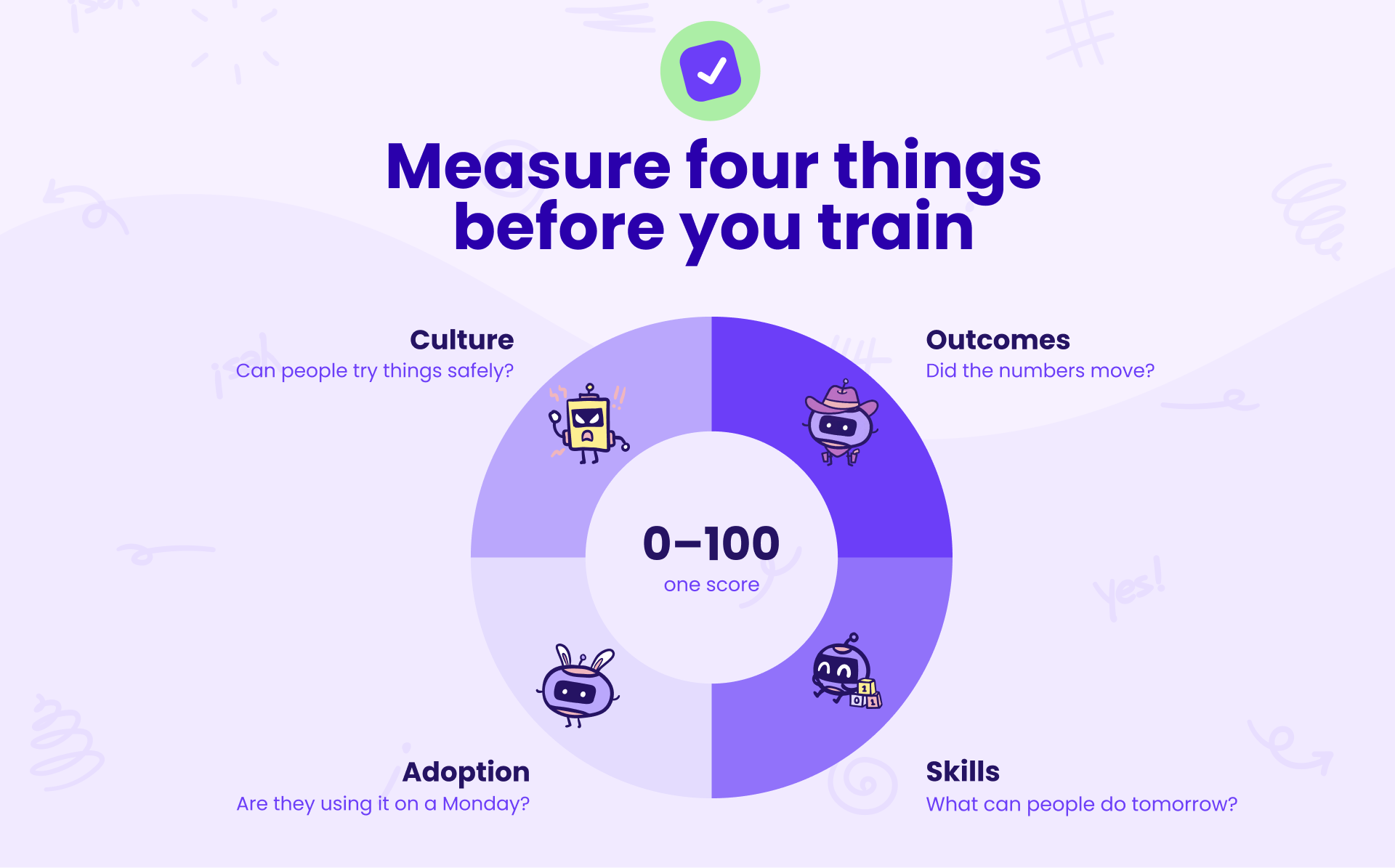
Outcomes: did anything change in the numbers? The productivity research has matured past surveys into real experiments. A field study of 5,179 customer support agents found 14% more issues resolved per hour with AI assistance (Brynjolfsson, Li & Raymond, 2023). A randomised trial in Science showed professionals finishing writing tasks 37% faster (Noy & Zhang, 2023). A study of 758 BCG consultants found 25% faster and 40% higher-quality work on tasks inside AI's sweet spot, and lower quality on tasks outside it (Dell'Acqua et al., 2023). AI does not make everything better. It makes some things much better and some things worse, and knowing the difference is itself a skill. In Bots & People's own work, Deutsche Telekom trained 18,000 employees and reported time savings of 1.9 hours per person per day. Numbers matter, and so do anecdotes, such as a single new use case that generates revenue, cuts cost, or reduces risk.
Skills: what can people do tomorrow morning? There is a progression that keeps showing up. UNESCO's AI Competency Framework moves from literacy through deepening knowledge to knowledge creation (UNESCO, 2024), and Bots & People describes the same idea as Understand, Use, Build. Someone has even built a scientifically validated questionnaire for AI skills, the MAILS scale, with twelve items across technical understanding, critical thinking, practical application and ethics, originally developed in German (Carolus et al., 2023). It was tested with students rather than enterprise workers, so the opportunity is to extend that scientific foundation for the enterprise context and to report not just "your people scored X" but "here is what they should learn next."
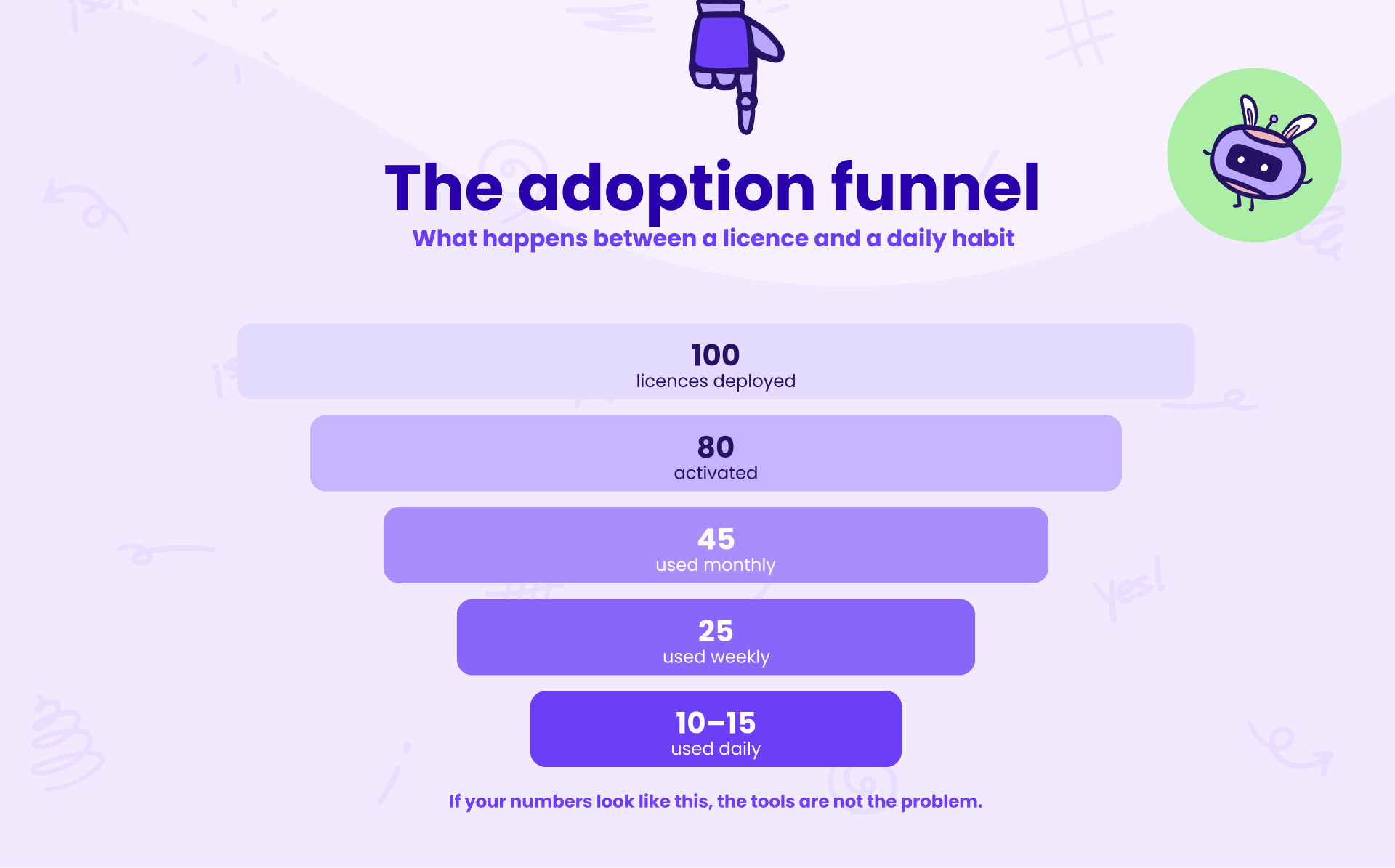
Adoption: is anyone using it on a Monday? This is where measurement gets tricky, because people over-report their own usage. Not dishonestly, just optimistically. The way around it is specific behavioural questions. "In the past five working days, how many times did you open an AI tool to help with a work task?" is much harder to inflate than "I generally use AI regularly." Across multiple data sources, the adoption funnel looks like this: 100 licences deployed, around 80 activated, 45 used monthly, 25 used weekly, and 10 to 15 used daily. If your numbers look like that, the tools are not the issue, and the real question is what happened between activation and habit. At Daimler Truck, Bots & People's work produced an 85% increase in Copilot Chat usage, which is an adoption number rather than a completion number.
Culture: can people try things without getting punished? Culture sounds like the soft dimension and is actually the hardest, and it is the strongest predictor of whether any of this works. The MIT/BCG survey of around 3,000 managers found that when executives actively champion AI, the value organisations get from it rises by up to 5.9 times (Ransbotham et al., 2024). Middle management is the lever nobody talks about, because people copy what their boss does, not what the training email says.
The point of measuring first is not the dashboard. It is the loop. You measure, find the gaps, train for those specific gaps, and measure again. Without the loop, training is an event people attend and forget. With it, training becomes a system that compounds.
The five-level AI learning model: Discover, Understand, Use, Integrate, Build
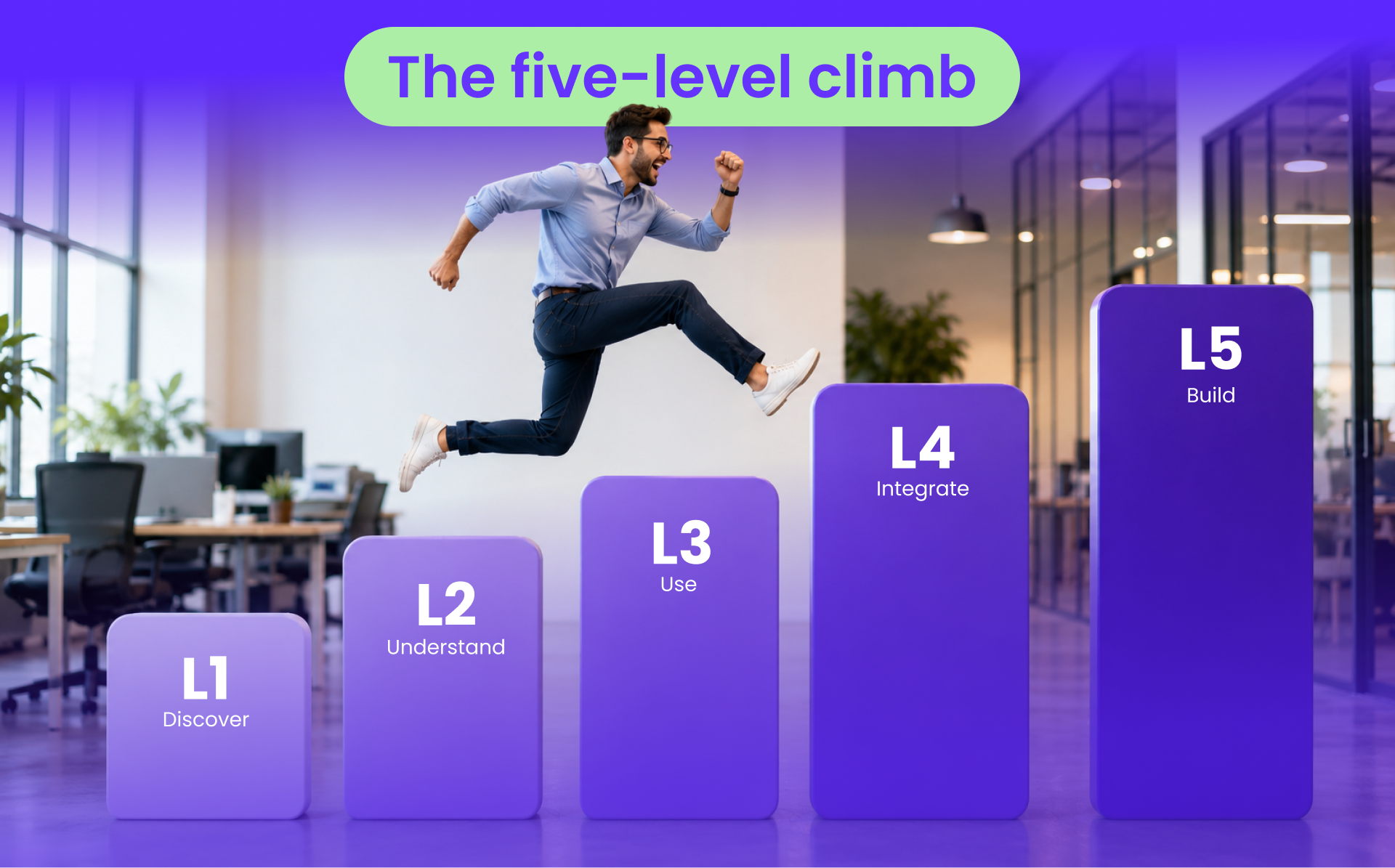
The five-level model describes the rungs an individual climbs: Discover (see what is possible), Understand (grasp the concepts and the rules), Use (apply tools to real work), Integrate (connect AI into team workflows and measure value), and Build (create and deploy scalable solutions like agents). It is content-agnostic, so any format can sit at any level based on what it achieves, not on how long it takes.
When Bots & People started building its training portfolio, it made the mistake everyone makes: a course catalogue. It was internally logical and reflected how the team thought about curriculum, and it was not built from the learner's point of view. When you are rolling something out to 20,000 or 100,000 people, a static catalogue is the wrong unit of design.
The model the team uses now has five levels, and it is the backbone of every learning concept Bots & People builds. It draws on the work of Werner Sauter on social blended learning, Karl Kapp on gamification, and Dr Philippa Hardman's learning-design methodology, but the idea is plain enough to put in a single table.
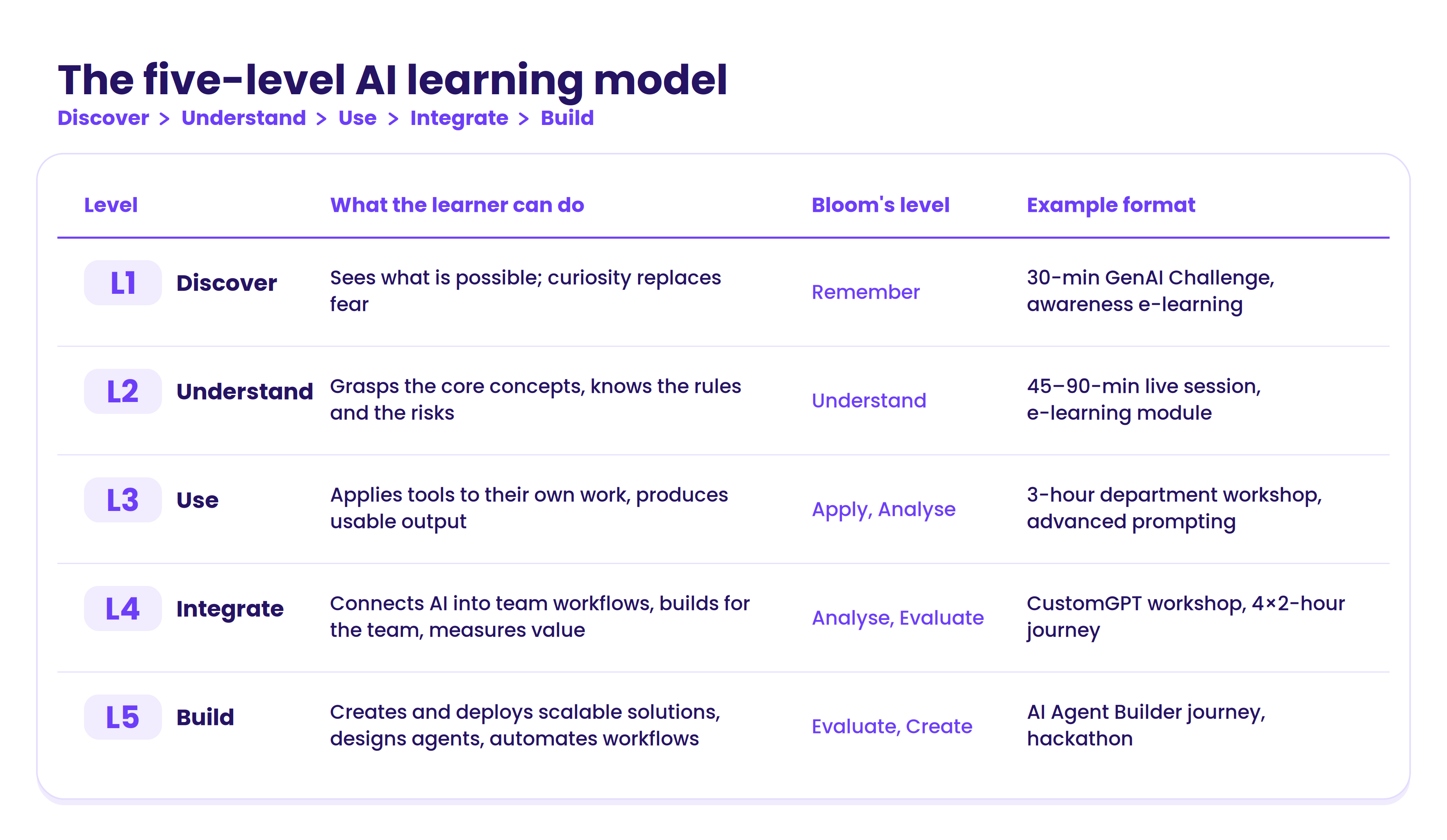
Two things make this more than a tidy taxonomy.
First, it is content-agnostic and reaches further than AI. The same five rungs work for data literacy, from data fundamentals at L1 to automated pipelines at L5, and for the Microsoft productivity stack, from M365 basics to custom automation in the Power Platform. The level describes what the learner achieves, so the content and the tools shift while the rungs stay the same.
Second, the five levels are the rungs an individual climbs, and they sit underneath a simpler three-stage structure that decides how you organise the rollout across a whole workforce. This is the connection most people miss. Discover and Understand together form the "Understand AI" stage, aimed at everyone. Use is the "Use AI" stage, aimed at every department. Integrate and Build together form the "Build with AI" stage, aimed at your champions. The five-level model tells you what good looks like for one person, and the three-stage model tells you how to move a population. You need both, and they fit together exactly.
How do you roll AI upskilling out across a whole workforce?
Roll it out in three stages that map onto the five levels. Stage 1, Understand, gives everyone AI literacy fast, from a 15-minute e-learning to a 60-minute webinar. Stage 2, Use, makes each department productive through live, hands-on, role-specific sessions. Stage 3, Build, turns the curious 5 to 10% into champions who create agents and pull colleagues forward. Run separate tracks for leaders, executives and developers alongside.
Stage 1: Understand. For everyone. The goal here is not productivity yet. It is a shared foundation and a permission slip: what generative AI is, which tools the company offers, what the EU AI Act means for me, and why I should care. Fear gets replaced by curiosity. The bar is deliberately low, because these formats are built for reach rather than depth, such as a 15-minute SCORM module on the company's AI policy that drops into any LMS, a beginner e-learning, or a 60-minute webinar for thousands at once. One thing surprises the team every time. A large part of the workforce struggles with the basics, like copying text from Teams into Copilot, sharing a screen, or working with a virtual whiteboard, so AI turns out to be a good reason to level up basic digital skills as well. Do not assume everyone starts from the same baseline.
Stage 2: Use. For every department. This is where the actual transformation happens and where the board-deck numbers come from. People move from understanding AI to using it on their real work. One format stands out, what Bots & People calls the AI Contest, a gamified 90-minute live session where teams compete in prompting challenges scored by an AI agent in real time. People leave having used AI fifteen to twenty times in ninety minutes, which is more than most employees manage in a month on their own. For more depth, three-hour department-specific workshops work well, because a procurement workshop uses procurement data and a marketing workshop uses marketing copy. The moment someone watches AI solve a problem they actually had that morning, something clicks, and that click never happens with generic demo data.
One format proves how well this scales. At Daimler Truck, Bots & People ran an AI Challenge inspired by Working Out Loud circles. It starts with a 60-minute live kick-off that hands people the basics and a set of challenges, and then learners form small self-organised groups that meet on their own, work through the challenges together, and help each other get unstuck, with no trainer in the room. The kick-offs ran across the whole organisation and the self-learning circles built their own momentum, pulling in colleagues who had never signed up. The 85% increase in Copilot Chat adoption at Daimler Truck did not come from a mandatory course. It came from people watching colleagues do something useful and wanting to try it themselves.
Stage 3: Build. For your champions. This targets the 5 to 10% who are ready to move beyond using AI into building with it. The output is working agents, automated workflows, and certified internal champions. The formats are learning journeys, usually four two-hour sessions with transfer tasks in between, where people build custom GPTs for their team or go further with Copilot Studio or n8n. Hackathons fit here too, with small cohorts of around 30 people prototyping real solutions to business challenges and presenting board-ready outputs.
Special tracks, run in parallel. Three groups need their own path rather than the standard stages. Leaders need a journey that equips them to drive adoption, not just to use AI themselves, and a 4×2-hour format with transfer tasks works well. Executives need something shorter and sharper, a three-hour strategic briefing or an ongoing masterclass that hands them decision frameworks, so they walk out and visibly champion AI in the next meeting. Developers need depth rather than breadth, working in their actual editor on their actual codebase with AI-assisted coding tools. At Siemens Energy, Bots & People focused exactly here, pairing executive coaching with hands-on Copilot Studio agent-building to move leaders from User to Creator.
The point of all this is not the number of formats on offer. It is the mental model that everyone in the organisation can follow: everyone understands AI first, then every department gets productive with it, then a core of champions sustains the change. If you want the operational detail, Bots & People covers how to roll AI training out across a global enterprise separately.
Why do live sessions beat off-the-shelf e-learning?
For Stage 1 awareness, self-paced e-learning is fine and scales infinitely. For Stage 2 and Stage 3, where the goal is behaviour change, live sessions win, because completion rates are not adoption rates. Someone who clicks through a video and passes a quiz has not changed how they work. Live delivery adds social pressure, real-time feedback, and the energy of a group, which a module cannot.
A question comes up constantly: why not just buy a content library and let people learn at their own pace? It would scale faster and cost less, and for Stage 1 it genuinely works. A 15-minute module on the EU AI Act scales through any LMS without a trainer in sight.
The problem starts at Stage 2. Too many organisations confuse course completions with capability, and they are not the same thing. So the backbone of everything at Stage 2 and 3 is live: people in a room, virtual or physical, doing things together with someone who can adjust in real time. Two delivery models have come out of doing this 80,000 times, and both work with internal trainers, external experts, or a mix.
The first is the short session, one to four hours in a single shot. These match how adults actually learn a new tool, because you watch a demo, try it yourself, get feedback, and try again. A tightly run 90-minute session where people are competing on a leaderboard and never get bored can beat a full-day seminar, and by the end participants have used AI fifteen to twenty times.
The second is the learning journey, four two-hour sessions spread across weeks with transfer tasks in between, which works like a flipped classroom. Each session introduces concepts and tools, and between sessions participants apply what they learned to their real work and bring the results, and the problems, back to the next session. The transfer tasks are the part that makes it work. Without them a workshop fades by Friday, and with them a leader builds their first agent after session two and presents it in session three, so the learning gets embedded into daily work in the space between sessions.
Why does live change behaviour when a polished e-learning does not? It comes down to three things. There is the social pressure to try something new in front of colleagues, the real-time feedback from someone who can see what is going wrong, and the energy of a group discovering something together. The discomfort of running your first prompt on a big screen while 25 people watch is exactly the discomfort that creates learning, and nobody gets that from a self-paced module. A learning hub with an AI tutor, exercises tied to the live content, and smart nudges can bridge the gap between sessions, but the live sessions stay the backbone, because people teaching people is what changes behaviour.
What comes after prompting?
After prompting come the durable human skills: deciding what to ask AI to do, judging whether the output is actually good, knowing when AI is the wrong tool, and designing workflows that split work between humans and machines. Prompting is a tool skill with a short shelf life, while these judgment skills transfer across every model and interface, so build programmes around capabilities rather than tools.
"Okay, our people can prompt now. But the AI keeps getting smarter, and soon it will just figure out what we want, so what do we teach next?" This question comes up at events, on calls, and in DMs, and it is a good one.
Prompting is a tool skill, and tool skills expire. The models are getting better at understanding sloppy instructions and the interfaces are getting simpler, so the specific syntax your team learned last quarter already feels dated. For AI interface skills specifically, the half-life runs around six to eight months, and for tool knowledge more broadly somewhere between six and eighteen.
What does not expire is the ability to decide what to ask AI to do in the first place, to judge whether the output is genuinely good or just sounds good, to know when AI is the right tool and when it is a waste of time, and to design a workflow where AI handles the repetitive part and a human handles the judgment. Ethan Mollick at Wharton describes the uneven shape of model capability as a jagged frontier. "AI has a jagged frontier," in his words, good at some things that look hard and bad at some that look easy, and you only learn its shape by using it. Working out where that frontier sits for your own job is a human skill applied to an AI context, and it transfers across every tool, every model update, and every new interface.
For L&D the implication is uncomfortable but clear: stop organising programmes around tools. "How to use Copilot" is a workshop that expires the next time Microsoft ships an update, while "how to evaluate and direct AI in your daily work" is a capability that compounds. This connects directly back to measurement. If your skills assessment asks "can this person use Copilot?", it is a question with an expiry date. If it asks "can this person critically evaluate an AI-generated output before sending it to a client?", it works today, next year, and in 2030.
Nine lessons from upskilling 80,000 employees
Nine patterns hold up across 80,000 trained employees in some of the largest companies in the DACH region. The organisations that measure first, build flexible ecosystems, back their pioneers, communicate in human language, and lead from the top get results. The rest get completion certificates and unchanged behaviour.
- Off-the-shelf learning is not enough. Buying a generic platform and rolling it out to 10,000 people feels productive, but every target group needs different things, and "AI Fundamentals" as a one-size-fits-all module produces completion rates, not capability. A developer who lives in VS Code needs something completely different from an HR business partner who lives in Outlook and Excel, so design the programme around the work, not the technology.
- Measure, then train, not the other way around. Most organisations buy a programme, run it, and then try to find out whether it worked. Measure first across Outcomes, Skills, Adoption and Culture, design for the specific gaps you find, then measure again. That is the loop, and without it you are guessing.
- Bring fun back into learning. AI is one of the rare topics where people actually want to learn, because they are curious and have already seen what ChatGPT can do. Do not kill that with a 47-page SOP on approved use cases and a compliance webinar. Let people experiment and discover what AI does for their own work by playing with it, and let the learning experience reflect that energy rather than feeling like another mandatory thing from corporate.
- Prioritise the pioneers. Ales Drabek, a Chief Transformation and Disruption Officer the team learned a lot from, advised early on to stop spending energy on the people who need everything explained ten times and to focus on the enthusiasts first. Find the 5 to 10% in every department who are already excited, give them advanced training and a stage to show what they built, and let them pull the rest forward. When someone in accounting shows their team they automated the monthly report, the sceptics suddenly get interested, not because L&D told them to but because their colleague just made them look slow. This is how you build a champion network that sustains the change.
- Build an ecosystem that can keep up. The half-life of AI tool knowledge runs six to eighteen months, which is far too short for a blockbuster e-learning that takes six months and €200K to produce. By the time your perfectly polished "How to Use Copilot" course is ready, Microsoft has shipped three updates and the interface looks different. Bots & People runs a network of 50-plus specialist trainers, so when Microsoft ships a Copilot update on a Tuesday, the workshop content is updated by Thursday. That is not because the team is fast. It is because the model is built for speed, with people teaching people rather than production studios making films.
- Communication is key, and most of it is too technical. Do not call it "LLM usage training," call it "how to talk to an AI." Do not call it "prompt engineering," call it "how to give good instructions." The moment your programme sounds like a computer science lecture you have lost most of the organisation. IT writes the training description, it reads like a GitHub readme, nobody outside IT signs up, and then IT concludes that nobody is interested in AI. Everybody is interested; they just could not understand the invitation.
- Special target groups need special treatment. A two-hour basics workshop works for the broad middle of an organisation and fails for executives, developers, and sales teams. Executives need coaching rather than workshops, because one hour next to an executive who then uses AI in a meeting that 200 people attend creates more impact than ten hours of group training. Developers need a sandbox, not a slideshow. Sales teams need speed, such as how to research a prospect in three minutes instead of thirty and how to draft a follow-up that does not read like a robot wrote it. Each of these is a case for role-specific AI training.
- If the top does not lead, the bottom will not follow. This is the one that makes or breaks everything. If the CEO, the CHRO and the CIO do not visibly use AI, the organisation treats it as optional, and optional things do not get adopted. The best programmes have leaders doing reverse mentoring with junior employees, writing a personal AI-usage note to their team about what worked and what did not, and presenting their own automations in town halls instead of reading a script someone wrote for them. When a senior leader says "I used AI to prepare for this board meeting and it saved me two hours," that does more for adoption than any training programme.
- One-to-one coaching scales better than you think. This sounds counterintuitive when you have 10,000 employees, but you do not coach all of them. You coach the 200 people whose behaviour shapes everyone else's. One hour with a head of procurement who then restructures how her team uses AI for vendor analysis creates more change than a workshop for 50 people who forget it by Friday. Pair it with the champion networks, so you train 500 champions in small groups and then give the top 50 individual coaching to turn them into multipliers who run the workshops, answer the Slack questions, and build the templates 5,000 colleagues end up using. The coaching investment is small and the ripple is large.
What to do next
If you are an L&D leader staring at a Copilot rollout and a vague mandate, here is where to start.
- Measure before you spend. Run a short, behavioural assessment across all four dimensions, so you know where people actually are rather than where leadership assumes they are. The AI Adoption Maturity Index is built for exactly this, with the first round of data collection running in 2026.
- Treat it as a product, not a project. Launch a minimum viable programme with one department, measure what changed within weeks, and make the next version better. Nobody will remember the date your programme launched, only whether it worked.
- Back your pioneers and get one leader using AI in public, because that single visible example does more than any all-staff email.
- Build around capabilities, not tools, so your programme survives the next model update and your skills assessment still makes sense in 2030.
Intelligence gets artificial, intention stays human, and the organisations that win the next few years will be the ones that take the human side as seriously as they took the technology. The full argument, with every source, lives in the whitepaper How to Make AI Work for People. If you would rather just talk it through, get in touch.
Frequently Asked Questions
What is enterprise AI upskilling?
Enterprise AI upskilling is the structured, organisation-wide process of moving every employee from awareness of AI tools to confident, daily use on real work. It is not a single course or a content library. It runs in stages, is measured by behaviour change rather than course completions, and treats culture and adoption as seriously as technical skill.
How is AI upskilling different from AI training?
AI training usually means a discrete event, such as a webinar or an e-learning module on a specific tool. AI upskilling is the broader, ongoing capability-building effort that includes training but also adds measurement, change management, role-specific tracks, and a feedback loop. Training is something people attend, while upskilling is something that changes how an organisation works.
Does the EU AI Act require AI training?
Article 4 of the EU AI Act has required a "sufficient level of AI literacy" for staff operating AI systems since 2 February 2025, and national authorities gain formal enforcement powers on 2 August 2026. It does not prescribe training hours or certificates. It requires organisations to ensure, and in practice to demonstrate, that their people are capable, which is difficult without measurement.
How do you measure the ROI of AI upskilling?
Measure four dimensions rather than one. Outcomes covers business numbers like time saved or issues resolved, Skills covers what people can actually do (ideally with a validated instrument), Adoption covers specific behavioural usage over the last five working days, and Culture covers whether people can experiment safely. Track them quarterly so you can connect training to behaviour change and to business impact.
How long does it take to upskill a workforce in AI?
A realistic enterprise timeline reaches everyone with AI literacy in roughly the first month, gets departments using AI daily by around month three, and produces certified internal champions and a board-ready impact review by about month six. It does not end there, because the tools keep changing. The point is a repeating quarterly loop rather than a single finish line.
Should we use e-learning or live training for AI upskilling?
Use both, by stage. Self-paced e-learning is efficient for Stage 1 awareness and compliance, such as a short module on the EU AI Act. For Stage 2 and Stage 3, where the goal is behaviour change, live sessions work better, because completion rates are not adoption rates and live delivery adds social pressure, real-time feedback, and group energy that a module cannot replicate.
What skills should we train after prompting?
Train the durable judgment skills: deciding what to ask AI to do, evaluating whether an output is genuinely good, knowing when AI is the wrong tool, and designing workflows that combine humans and AI. Prompting syntax has a short shelf life, while these capabilities transfer across every model and interface, so build programmes around capabilities rather than around specific tools.
What is the first step to upskilling our people in AI?
Measure before you train. Run a short, behavioural assessment across Outcomes, Skills, Adoption and Culture, so you understand where people actually are rather than where leadership assumes they are. The gaps you find tell you what to build, which department to start with, and what to leave out, and they give you a baseline to prove impact against later.
About Bots & People
Bots & People is a Berlin-based enterprise AI upskilling company and Microsoft Training Services Partner. It has delivered AI upskilling programmes for Deutsche Telekom, Daimler Truck, Siemens Energy and more than 30 other DACH enterprises, with over 80,000 employees trained. The company was co-founded and is led by CEO Nico Bitzer. Follow Bots & People on LinkedIn.