Last updated August 2026 · 9 min read · By Nico Bitzer, Co-Founder & CEO, Bots & People
Shadow AI is the use of AI tools that an employer has not approved, provided or made visible, usually through personal accounts on consumer chatbots rather than through a company deployment.
TL;DR
- McKinsey found that 88% of organisations now use AI in at least one business function, while only 6% attribute more than 5% of EBIT to it, and the distance between those numbers is a people problem rather than a technology problem.
- Four in ten German companies assume their employees already use private generative AI accounts for work, and only 26% give their people an official route to a tool (Bitkom Research, 2025).
- Bans do not remove the behaviour, they remove the visibility, so the organisations that shrink shadow AI supply a sanctioned tool, teach people to use it on their real work, and make usage safe to talk about.
A few weeks ago I moderated an AI summit in Munich. I knew several of the speakers already, all of them serious people, several with doctorates, all genuinely excited to get on stage and talk about autonomous agents and multimodal architectures. The next morning I was on a video call with a client's HR team, and the question on the table was whether their employees were allowed to paste something into ChatGPT. That was not a rhetorical question. They honestly did not know the answer.
Those two worlds are one day apart. This article is about what lives in the gap between them, which is a large amount of unsupervised, unmeasured and untaught AI use that nobody planned for.
How big is the gap between AI adoption and AI value?
The gap is now measurable, and it is wide. McKinsey's State of AI survey, published in November 2025 with 1,993 respondents across 105 countries, found that 88% of organisations use AI in at least one business function. Only 39% could point to any EBIT impact at all, and most of those put it below 5%.
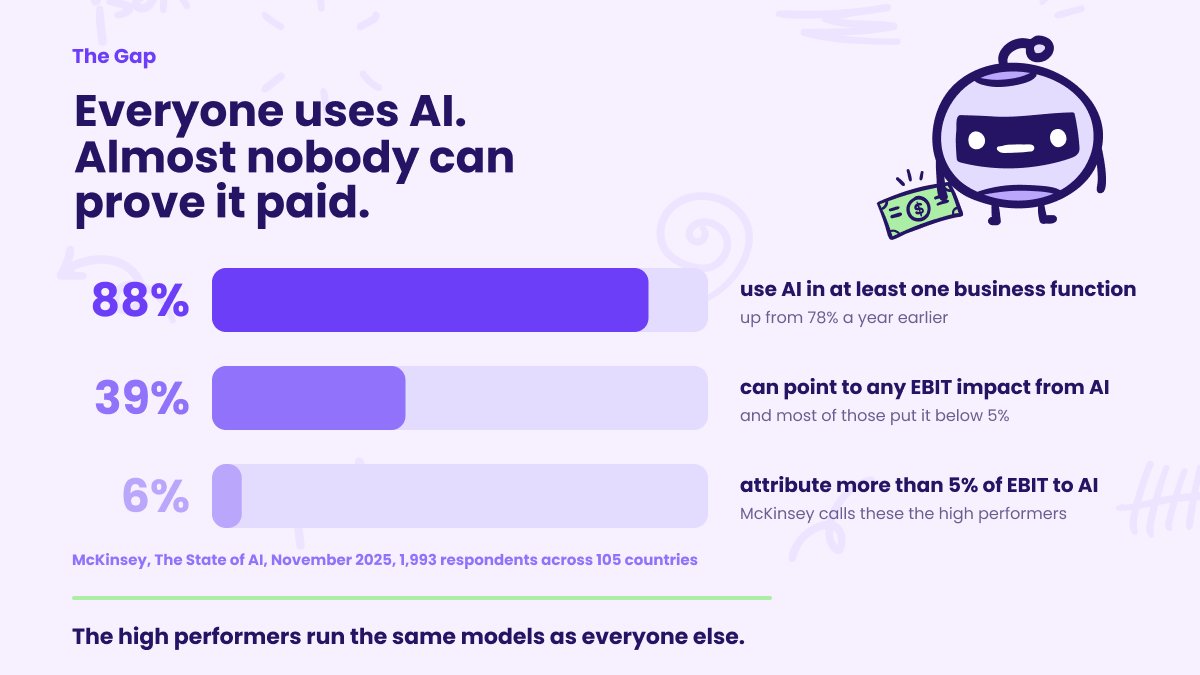
Around 6% clear McKinsey's bar for high performers, meaning they attribute more than 5% of EBIT to AI and report significant value from it. The interesting part is that the high performers and everyone else are running the same models. What separates them is organisational: McKinsey found high performers were far more likely to have fundamentally redesigned how work gets done rather than layering AI on top of existing processes.
BCG reached the same conclusion from a different angle, finding in its survey of roughly 2,700 executives that 26% had moved past pilots to value at scale. Adoption is close to universal and impact is rare, which means the constraint sits somewhere between the licence and the person holding it.
What is shadow AI, and how common is it in German companies?
Shadow AI is common enough that most companies can no longer rule it out. Bitkom Research surveyed 604 German companies with 20 or more employees in mid-2025 and found that 8% describe private AI use at work as widespread and another 17% see isolated cases. A further 17% suspect it without being certain.
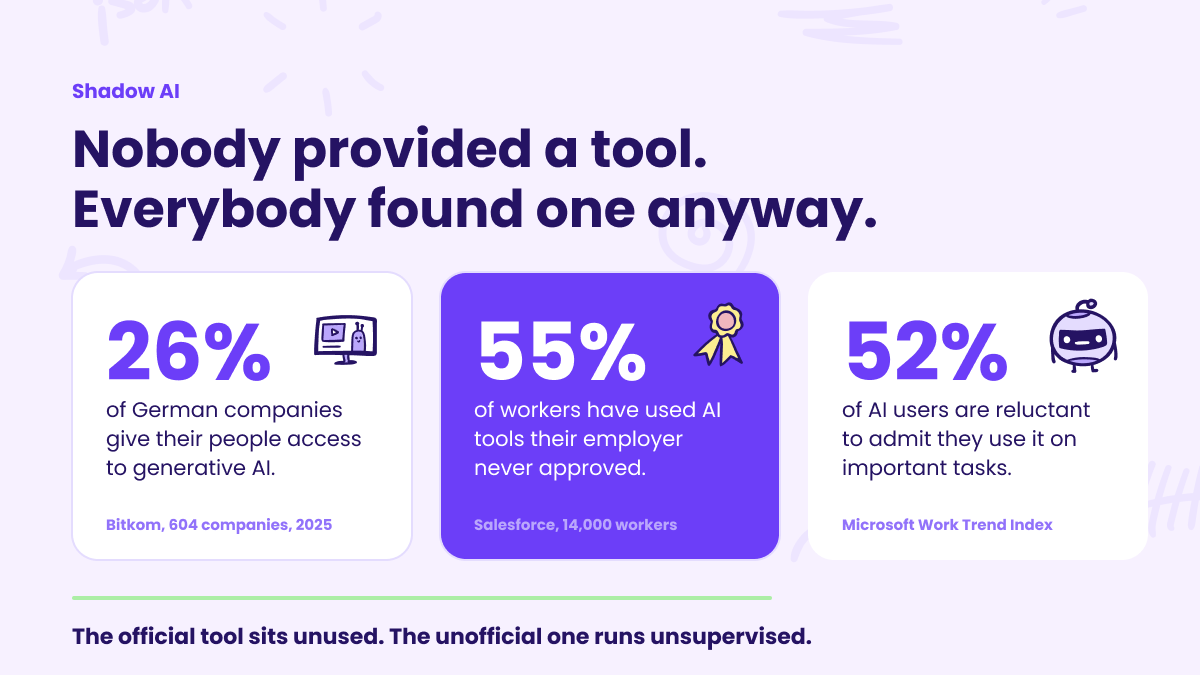
The more revealing number is the one moving in the other direction. In 2024, 37% of companies were certain that no private AI access was happening in their organisation. A year later that figure had fallen to 29%, according to Bitkom's own reporting on shadow AI. Confidence is draining out of the category, and nothing has replaced it.
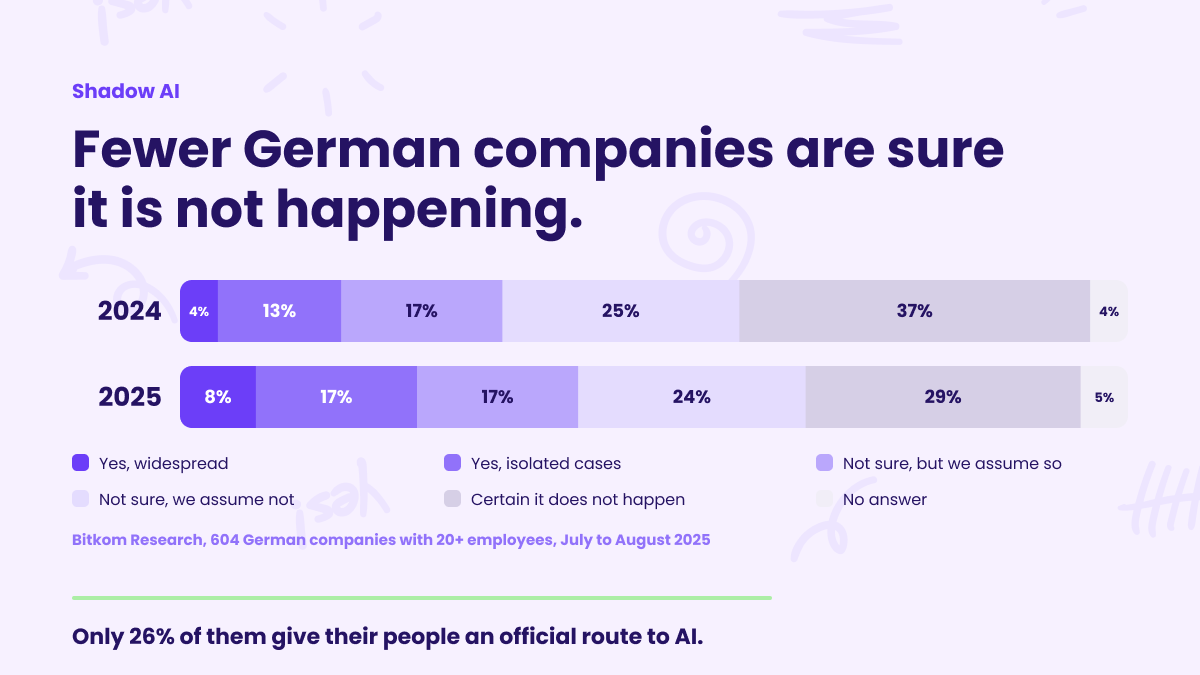
The international picture is consistent. Microsoft's 2024 Work Trend Index, based on 31,000 workers across 31 countries, found that 78% of AI users bring their own tools to work. Salesforce surveyed more than 14,000 workers and found that 55% had used generative AI tools their employer had not approved, while 40% had used tools that were explicitly banned. Only 21% of those companies had a clearly defined policy on approved tools and use cases at all.
Why do employees hide the AI they use?
Employees hide AI use because disclosure carries a personal cost and no personal benefit. Microsoft found that 52% of people who use AI at work are reluctant to admit they use it on their most important tasks, and 53% worry that doing so makes them look replaceable. The behaviour is rational under those conditions.
There is a second reason that gets less attention, and it is about competence rather than fear. Salesforce found that 69% of workers had received no training from their employer on using AI at work, and Microsoft put the share of AI users who had received company training at 39%. Someone who has never been shown what good AI use looks like has no way to demonstrate that their use was appropriate. Silence is the safer option.
The consequence shows up in the gap between what executives believe and what people report. PwC surveyed workers for its 2025 Global Workforce Hopes and Fears Survey and found that only 14% use generative AI daily, rising to 19% among office employees. PwC notes plainly that this sits well below the estimates executives usually give. Both the overstatement in the boardroom and the understatement on the floor come from the same place, which is that nobody is measuring the behaviour directly.
What does shadow AI actually cost an organisation?
Shadow AI costs an organisation on three fronts at once, and only one of them belongs to the security team.
The first cost is data exposure. Cyberhaven Labs analysed billions of data movements across 222 companies for its 2026 AI Adoption and Risk Report and found that 39.7% of interactions with AI tools involve sensitive data, which works out at the average employee putting proprietary information into an AI tool roughly once every three days. Around a third of employees reach those tools through personal accounts, which puts the activity outside every control the company has.
The second cost is quality, and it is quieter. Work produced by an untrained user gets sent to a client, a supplier or a works council without anyone checking whether the model invented a figure. Salesforce found that 64% of workers had passed off generative AI output as their own. Nobody reviews what nobody admits to.
The third cost is the one that lands on L&D, and it compounds. When usage is invisible, you have no baseline, no catalogue of real use cases, and no idea which departments are three months ahead. The next training programme then gets designed on assumptions instead of evidence. We wrote about the measurement side of this in why waiting for the business to ask for AI training fails, and shadow AI is the reason the baseline is so hard to establish in the first place.
That third cost also explains why the problem stays unowned. IT can see licences and feature activation, so it reports deployment. L&D can see course records, so it reports completion. Neither system can see a browser tab on a personal account, which means the one behaviour that decides whether any of this creates value is the one nobody is responsible for reporting.
Why do AI bans and policies fail?
Bans fail because they address the symptom while leaving the cause untouched. An employee reaches for a personal AI account when the sanctioned path is missing, slower or unclear. A policy that forbids the personal account does not create a sanctioned path, so the behaviour continues with one change: it becomes harder to see.
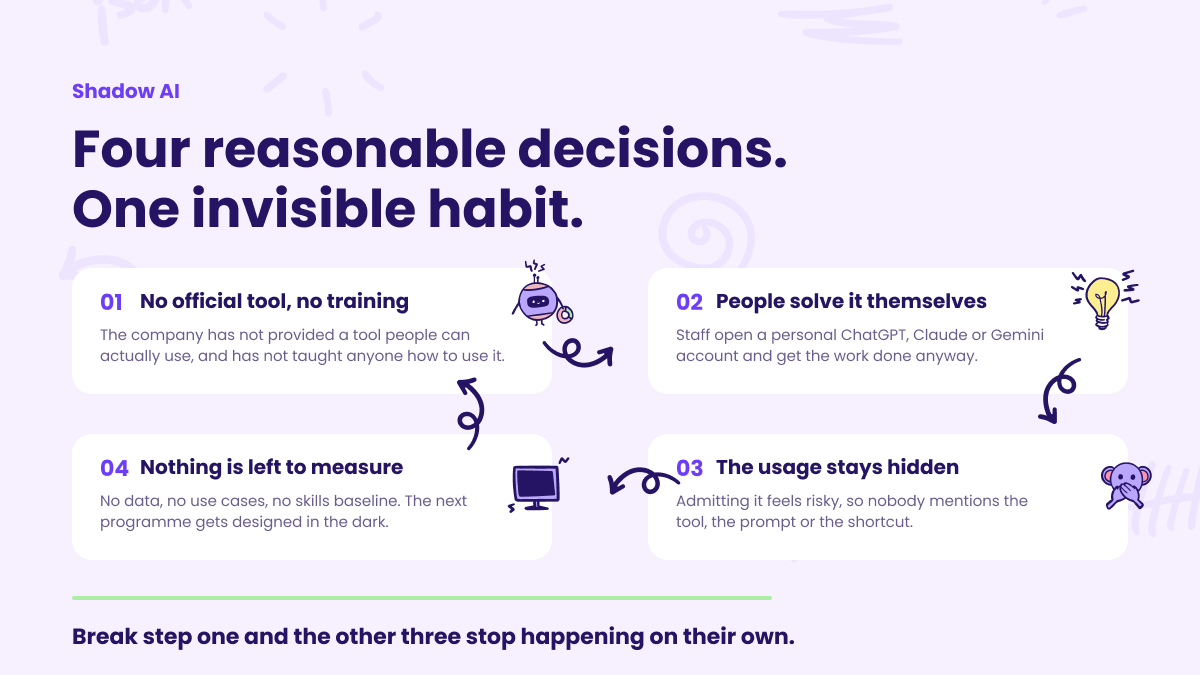
The supply side of this is measurable. Of those 604 German companies Bitkom surveyed, only 26% actually provide their employees with access to generative AI. Bitkom President Ralf Wintergerst framed the response as a combination rather than a choice, arguing that companies need clear rules for AI use and need to provide their employees with the technology themselves. Rules without supply are an instruction to keep doing the same thing more carefully.
There is also a compliance angle that makes suppression actively counterproductive. Article 4 of the EU AI Act requires organisations to support AI literacy among the people operating AI systems on their behalf. An organisation that has driven its AI use underground cannot describe what its people do with AI, let alone evidence that they are capable of doing it responsibly.
How do you bring shadow AI into the open?
You bring shadow AI into the open by making the sanctioned route the easier route, and then by teaching people to use it on work they actually have. The sequence matters. Supply comes first, because a training programme for a tool nobody has access to produces frustration rather than capability. Skills come second, because access without competence produces the output quality problem described above. Visibility comes third, because people only report their usage once reporting has stopped being a risk.
That last point is the one most programmes skip. In our work with Daimler Truck, the shift came from putting people in sessions built on their own departmental data, where using AI in front of colleagues was the expected behaviour rather than a confession. The programme reached 20,000 participations across six countries and Copilot Chat usage rose by 85%. That last figure is an adoption number rather than a completion number, which is the distinction that decides whether a board funds a second year.
The same pattern held at PwC Germany, where people moved from everyday Copilot use up to building agents and automations. In both cases the enthusiasts were already there before we arrived. They had been using AI privately for months. What changed was that the company gave them a stage instead of a policy.
The screensaver problem has a twin. One expensive licence sits unopened on a company laptop while the person holding it does the same work in a browser tab that nobody can see. Both failures have the same cause, which is that the organisation bought a tool and skipped the part where people learn to use it. That is also the honest answer to the 88% and the 6%.
What to do next
- Ask your people directly, this quarter. Run an anonymous survey with a time-bounded behavioural question, such as how many times someone used an AI tool for a work task in the past five working days, and ask separately whether the tool was company-provided. The gap between those two answers is your shadow AI figure.
- Check your supply before you check your policy. If fewer than half your employees have access to a sanctioned generative AI tool, the policy is not the constraint.
- Find your existing users and give them a role. The 5 to 10% who taught themselves are your fastest route to a real use case library, and they will only come forward if the first response is not disciplinary.
- Train on real departmental data, not on generic prompting. A procurement session should use procurement documents, because that is what converts a curious user into a daily one.
- Report adoption to your board rather than completions, so that the number you present describes behaviour that changed.