TL;DR – Key takeaways for L&D
- Traditional AI training often fails because it’s passive, theoretical, and disconnected from real work.
- Intentional gamification in learning boosts motivation, engagement, and behavior change - especially when tied to real tasks.
- L&D’s role is to design psychologically safe, impact-focused AI learning experiences that lead to measurable workplace change.
What you will learn today:
→ 💥 Why traditional AI training falls flat
→ 🧩 How game mechanics change learning and behavior
→ 📚 What research really says about gamification
→ 🎯 How to design gamified AI training that drives real adoption
Let’s be honest: a lot of AI training in companies still looks like this: A long slide deck. Some buzzwords. Maybe a demo. Everyone nods politely, then goes back to doing things the old way.
If you’re in L&D, you’ve probably heard the follow-up question:
🧐 “So… how do we know any of this AI training is actually changing behavior?”
This is where gamification in learning becomes more than a trendy word. Done right, it’s a way to turn passive “awareness sessions” into high-engagement learning experiences that actually shift how people work.
At Bots & People, we’ve seen this in our AI Gamified Contests, where people don’t just hear about AI but they compete, experiment, and build use cases that matter to their teams. Still, before we talk formats, let’s look at what the research says:

💥 Why traditional AI training falls flat
Most AI trainings struggle for three simple reasons:
- 🥱 They’re passive.
- People are expected to listen about AI instead of playing with tools, prompts, and workflows. It’s like teaching someone to swim from the shore.
- 😐 There’s no emotional hook.
- If a session feels like a compliance module, the brain doesn’t tag it as important. There’s nothing at stake, nothing to win, nothing to be proud of.
- 👾 There’s no clear “win condition.”
- Learners leave thinking, “That was interesting… but what exactly should I do differently tomorrow?”
Reviews of gamification in education and training consistently show that motivation, clear goals, and active engagement are critical drivers of learning outcomes. Without those ingredients, even great content silently dies in the LMS. Gamification, when it is rooted in real work, is one way to fix that.
🧠 How game mechanics change learning and behavior
Gamification sometimes gets reduced to “points and badges,” but there’s solid science underneath it.
Neuroscience and learning research on motivation and reward in learning and neurocognitive plasticity point to a few mechanisms that matter for L&D:
- ⚡️ Dopamine from clear goals and feedback
- When learners have a clear mission (e.g., “reduce reporting time by 30% with AI”) and get fast feedback (scores, results, peer reactions), the brain’s reward system lights up. That reward signal doesn’t just feel good, it strengthens memory and motivation.
- 💜 Emotion and challenge boost retention
- Moderate challenge, time pressure, and playful competition create emotional arousal that helps people remember what they did and why it mattered.
- 🧪 Active experimentation rewires habits
- Game‑like formats push people to try, fail safely, adjust, and try again. Over time, that active loop supports neurocognitive plasticity, our ability to build new patterns of thinking and behavior.
In simple L&D terms: when learning feels like a meaningful game, people stick with it, remember more, and are more likely to change how they work.
📚 What research really says about gamification
If you talk to stakeholders, you need more than “it’s fun.” You need evidence they can trust.
Research on gamified learning and technology‑enhanced learning shows a clear pattern: people learn more and stay engaged when they know the goal, get feedback, and can actively take part. Impact is highest when game elements are tied to real work, not just added on top as extra points or badges.
That’s why competitive, team‑based AI challenges are so powerful for upskilling: people are trying out real use cases, improving their own workflows, and seeing the impact of AI in their day‑to‑day work.
🏆 Why competition and play are so powerful for AI skills

Now, let’s zoom in on AI upskilling.
AI is one of those topics where many employees feel a mix of curiosity and anxiety. That’s exactly where gamified AI training can help.
Imagine two versions of an L&D initiative:
- Version A: a webinar on generative AI, a slide deck, and a quiz.
- Version B: a team-based AI challenge, where people earn points for:
- Designing prompts that save real time
- Automating a clunky process
- Presenting the most impactful use case in a short pitch
Adding social interaction and competition tends to strengthen behavioral outcomes. People are more likely to actually do something with what they learned.
In practice, we see:
- Quieter learners stepping up because the team depends on them
- “Non-technical” employees surprising themselves with what they build
- A healthy sense of “If they can do it, I can at least try”
This is where gamification stops being a gimmick and becomes a behavioral catalyst for AI adoption.
🚫 Common L&D mistakes with gamification (and better options)
However, gamification can absolutely backfire if we use it as a quick fix. Research and practice point to a few traps.
1. Points without purpose (and no link to real work)
Just slapping points and badges on top of the same old content doesn’t magically make it better. Learners spot it instantly, and nothing really changes in their day‑to‑day work.
🙌 Better: Reward real behavior change, not just activity.
For example:
Give points for AI use cases that were actually tested in a real workflow and made someone’s life easier, not just for “completing a module” or “attending a session”.
👉 That way, every game mechanic quietly nudges people toward the behaviors you actually want to see at work.
2. Over‑gamifying and increasing cognitive load
If people need a mini‑tutorial just to understand the rules of your challenge, you’ve already lost some of them. One study found that certain elements, like badges used in isolation, increased cognitive load without adding real value.
🙌 Better: Start with the simple structure we covered earlier: one clear mission, a few rounds, and transparent impact‑based scoring. You can always add extra mechanics later if (and only if) they serve a learning goal, not just because “more game = more fun”.
3. Ignoring your stakeholders’ success metrics
You can run the most fun AI challenge in the world but if your stakeholders can’t connect it to their metrics, it stays in the “nice L&D experiment” bucket.
🙌 Better: Translate your gamified AI training into numbers and outcomes your CFO, CHRO, and business leads care about:
- Hours saved per month
- Fewer errors or rework loops
- Faster onboarding / time‑to‑competence
- Number of AI‑powered workflows that are now “business as usual”
Use the challenge to surface these wins, then pair the numbers with a few strong learner stories in your debrief. That’s where gamification stops being a gimmick and becomes a behavior‑change engine they actually want to invest in.
🎯 How to design gamified AI training that drives real adoption

Good gamified AI training should feel like a friendly team mission, not a school exam. People play with real AI use cases over a few weeks, know exactly what “winning” looks like, and get credit for real impact, not just attendance. The goal is to turn small experiments into visible wins that stick in day‑to‑day work.
- Clear mission: Teams work toward one specific goal over a set period, such as freeing up hours with AI.
- Weekly sprints: Each week, teams select a process, build an AI workflow, and test it.
- Impact‑based scoring: Points reflect real outcomes like time saved and solution reusability.
- Final demo session: Teams present their best use cases to share learning across the organization.
When you strip it down, the recipe is simple enough to reuse as a checklist: set clear goals, build in feedback loops, and design challenges around authentic tasks.
💜 Stories > scores: how L&D can sell the impact
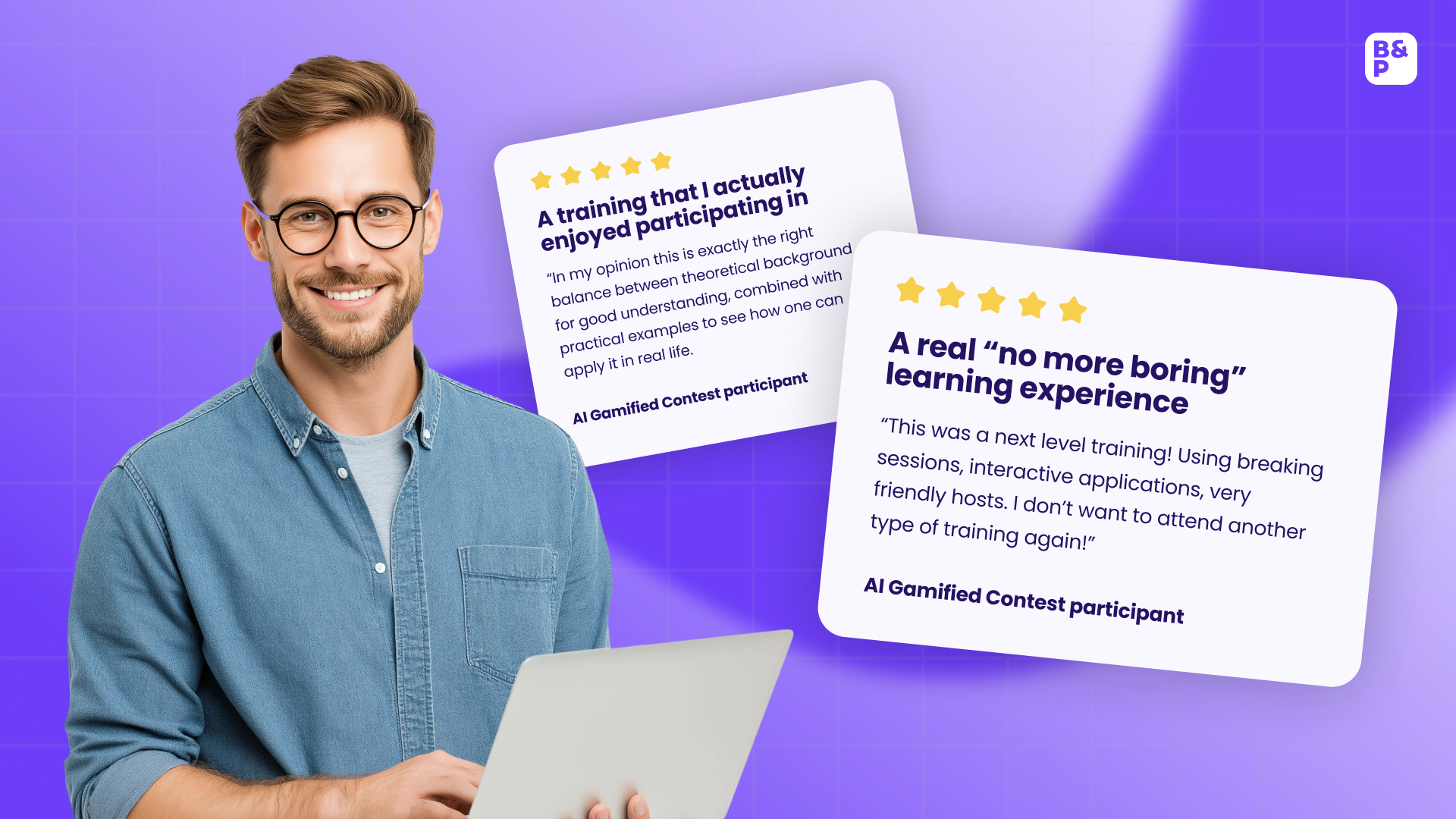
But how can I sell this idea to my stakeholders? We know stakeholders love numbers, we do too! But people remember stories better.
Research in psychology and education shows that narrative and emotion improve recall and make information more “sticky” than numbers alone. So when you’re presenting the impact of gamified AI initiatives, combine:
- Quantitative data
- Participation and completion
- Time saved
- Number of AI-powered workflows created
- Human stories
- “Our operations coordinator now creates reports in half the time.”
- “A skeptical manager turned into the strongest AI ambassador after winning a challenge.”
- “Teams now share prompt libraries instead of reinventing the wheel.”
That blend is what turns gamified AI training from “a cool L&D experiment” into a strategic capability-building lever.
🔚 Wrapping it up: gamification as a serious tool in L&D
For L&D, gamification in learning is not about making everything cute and game like. It is about borrowing what games already do well: clear goals, feedback, challenge and social play. The point is to design learning that actually changes behavior.
When you apply that to AI:
- People go from hearing about AI to using AI.
- Teams move from one-off training to ongoing experimentation.
- The organization sees measurable behavior change rather than just attendance reports.
The next step is L&D stepping confidently into the role of experience designer, not just content owner. Because in the end, the goal isn’t to build the most impressive learning game. The goal is to help people feel curious, capable, and ready to work with AI together.
🎮 What’s next? See gamification in action!
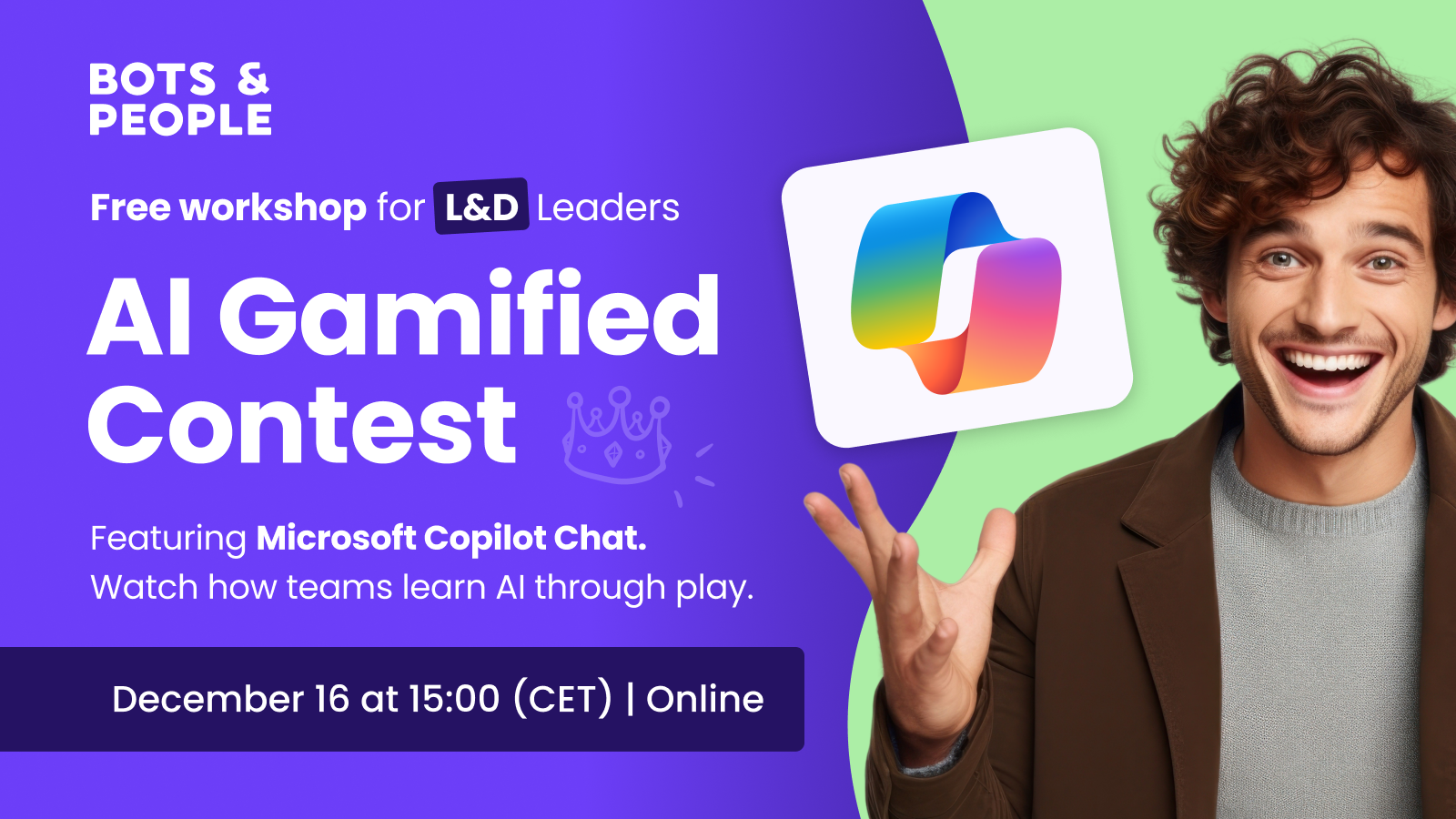
Reading about gamification is one thing. Watching people light up when they play with AI is another 😎
If you’d like to see how these ideas look in real life, join our upcoming Gamified AI Training session. We’ll walk through the challenge format, share concrete use cases from teams, and give you space to ask all your L&D‑nerd questions.
👉 Save your spot for the session on Gamified AI Training
Bring your questions, your skepticism, and a use case or two from your own learning programs.